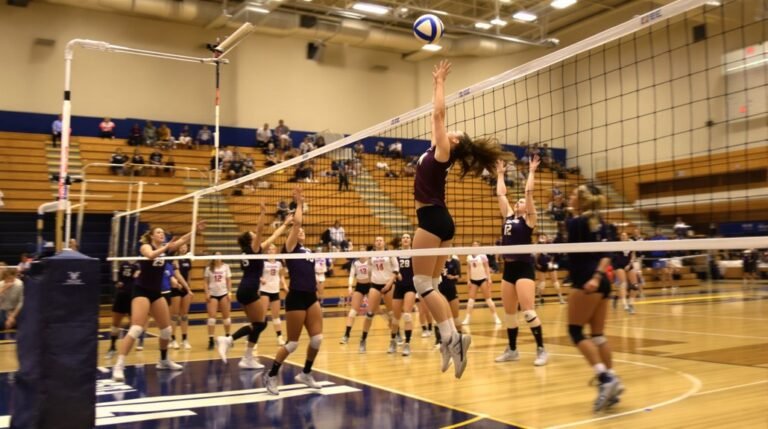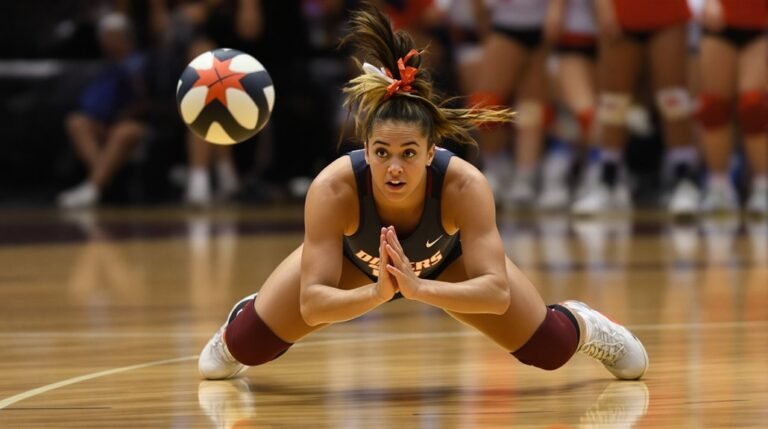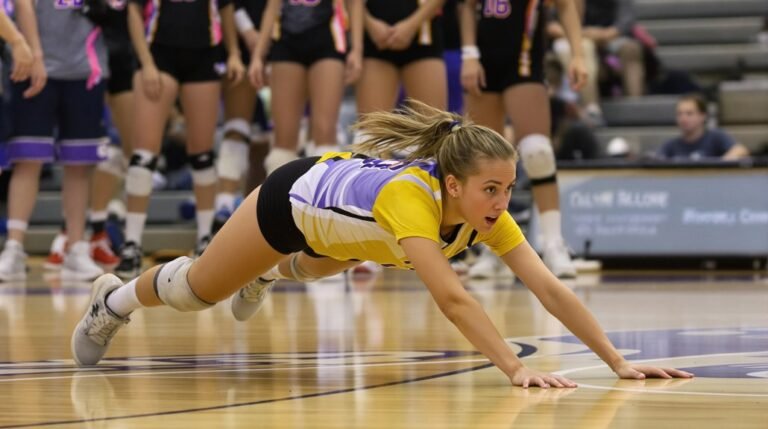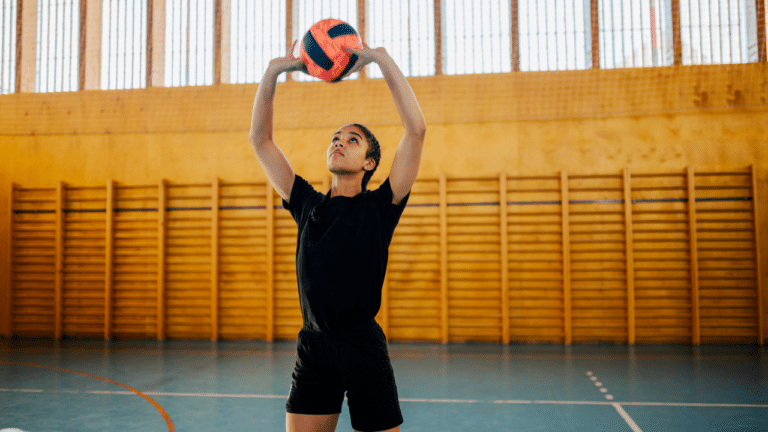


If you’ve ever watched a volleyball match, you’ve probably noticed the player on the left side who seems to get the ball more than anyone else—that’s the outside hitter. This position carries one of the heaviest workloads on the court, demanding skills in attacking, passing, and defense. Understanding what an OH actually does will change how you see the game and what it takes to play there.
Key Takeaways
- The outside hitter dominates the left side of the court as the team’s primary offensive weapon, receiving 50-60% of all sets.
- This position balances heavy attacking responsibilities with serve-receive duties, requiring both power and ball control skills.
- Outside hitters attack from position 4 in front row and execute back-row pipe attacks while contributing defensively with digs.
- They block against opponent right-side hitters, communicate with teammates, and coordinate closely with setters on preferred set locations.
- The role demands explosive jumping ability, quick decision-making between tooling, tipping, or driving attacks based on blocker positioning.
What Is an Outside Hitter in Volleyball?
An outside hitter dominates the left side of the court, serving as the team’s primary offensive weapon and receiving roughly 60% or more of all sets during a match. You’ll find this player attacking from position 4 in the front row and contributing from the back row as well.
The outside hitter goes by another name: left-side hitter. This position demands versatility you won’t find elsewhere on the court. You’re not just swinging at sets—you’re also a primary passer in serve-receive formations. That dual responsibility makes the role physically and mentally demanding.
Strong jumping ability and quick footwork are essential. You’ll often attack from imperfect passes, adjusting on the fly to put the ball away. It’s a position built for athletes who thrive under pressure.

Primary Attacking Responsibilities of the Outside Hitter
Outside hitters carry the heaviest offensive load on the court, handling roughly 60% or more of all sets during a typical match.
As the team’s primary attackers, you’ll find them stationed on the left side, position 4, where they face the opponent’s strongest blockers play after play.
Your job as an outside hitter means converting all types of passes into kills. When the pass drifts off target or comes in too low, you still need to put the ball away.
This requires mastering both powerful cross-court swings and sharp line shots. You’ll also develop the skill of tooling the block—intentionally hitting off the blocker’s hands to score points when a clean kill isn’t available.

Train Like a Pro: Volleyball Spike Trainer for All Skill Levels — This professional-grade spike trainer helps athletes at every level develop explosive hits and razor-sharp serves. Its innovative question-mark hook design replicates real-game ball resistance, with biomechanical studies showing a 30% increase in spike-specific muscle memory. You'll find yourself instinctively making better moves on the court, reacting faster, and hitting with more power and precision.

Complete Volleyball Training Set: the volleyball training equipment aid includes 1 piece of volleyball rebounder with elastic cord, 1 volleyball training wristband, 1 volleyball bracelet, 1 volleyball drawstring bag, 1 pair of volleyball arm braces, 1 pair of volleyball knee braces, 1 volleyball headband, the complete set is convenient for your daily volleyball training and practice
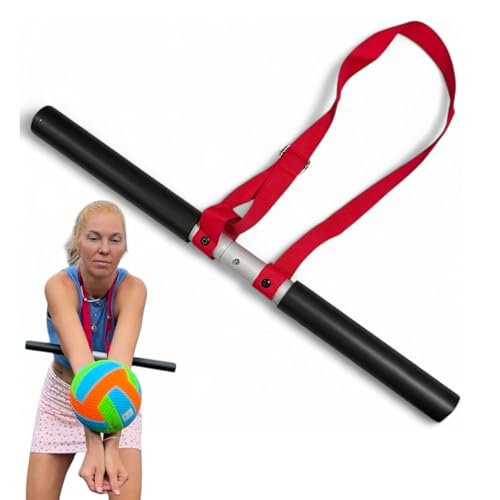
IMPROVE PASSING TECHNIQUE: The Boardee Bump-Pass volleyball gear helps you master proper arm positioning by keeping your arms straight and locked during bump-pass drills; build muscle memory for more consistent, accurate passing during solo or team practice
Serve-Receive and Passing Duties
Beyond their attacking duties, you’ll spend a significant portion of each match handling serve-receive responsibilities. As an outside hitter, you’re typically positioned in left-front, left-back, or middle-back depending on your rotation. Coaches expect you to deliver target passes within 2–3 meters of the net, right where your setter wants them.
You’ll need to handle everything servers throw at you—floats, topspin, and jump serves. At competitive levels, keeping your pass error rate under 10–15% per rotation is the goal. That takes a stable platform and solid directional control.
Communication matters too. You’ll work with your libero to assign serve zones and call out adjustments based on server tendencies. After passing, you’ve got just 1–3 seconds to shift into your attacking position. It’s demanding work.


Volleyball passing trainer that helps athletes improve their passing technique by limiting arm swing

Volleyball Training Equipment Aid: The volleyball equipment is a must-have for players of all levels who are looking to improve their serving, setting, and spiking skills. It provides a comprehensive training experience that targets all aspects of the game.

【Partner-Free Solo Training Structure】This professional solo volleyball trainer features a built-in rebound structure for continuous volleyball practice. Equipped with a premium volleyball rebounder, the device delivers automatic ball return after each strike, enabling smooth volleyball equipment training without repeated ball pickup. This standard volleyball training aid supports stable rhythm for daily independent volleyball training.
Blocking Skills and Defensive Positioning
Passing is only part of your defensive game—you’ve also got to hold your own at the net. As an outside hitter, you’ll block against the opponent’s right-side and opposite hitters, often forming a double block with your middle blocker.
Defense at the net is just as critical as passing—outside hitters must block effectively alongside their middle blocker.
Here’s what strong OH defense looks like:
- Read the setter and hitter approach to close gaps quickly along the net
- Shift laterally toward the pin at 1–2 meters per second to seal off angles
- Communicate with your libero and middle blocker to cover seams
- Dig tips and off-speed shots, aiming for 3–8 digs per set
Your block hands should angle to redirect shots or seal the line. Call “mine” or “yours” on short balls to avoid confusion.
Front-Row vs. Back-Row Roles
When you rotate through the six positions on the court, your job as an outside hitter shifts dramatically between front-row and back-row play.
In the front row, you’re the primary scoring threat. You’ll receive about 60% of all sets and attack from position 4 with high-powered spikes. You’re also responsible for blocking the opponent’s right-side and middle hitters, timing your jumps to penetrate above the net alongside your middle blocker.
The back row demands different skills. You’ll serve as a primary passer in serve-receive and dig attacks to fuel your team’s offense. Back-row attacking from position 6 requires you to hit pipe attacks off-platform, adjusting to imperfect sets while still creating scoring opportunities. This constant rotation requires serious endurance and adaptability.

Physical Attributes and Athletic Requirements
Generating the explosive power needed to attack from position 4 requires a specific athletic profile that separates outside hitters from other positions. Unlike a middle hitter who operates closer to the net, you’ll need vertical jumps reaching 0.6–0.9 meters to generate powerful spikes from the antenna. Your explosiveness must convert a 3–4 step approach into maximum takeoff velocity.
Here’s what you’ll need physically:
- Lower-body strength: Squatting 1.6–2.0× your bodyweight supports repeatable high-contact hits
- Fast-twitch power: Covering 8–12 meters in quick approach steps demands explosive leg drive
- Shoulder conditioning: Strong rotator cuffs and overhead mobility protect against overuse injuries
- Aerobic/anaerobic fitness: You’ll sustain repeated attacks across long rallies and multiple rotations
These attributes help you perform consistently throughout matches.
Communication and Court Awareness
Beyond the physical demands of attacking, your effectiveness as an outside hitter depends heavily on how well you communicate with teammates and read the court.
Before each serve, you’ll call out the server’s tendencies and confirm who’s taking which passing zones. This constant chatter keeps everyone aligned.
Constant communication before every serve keeps your team synchronized and eliminates confusion in passing lanes.
Your communication with the setter happens on every single play. You signal whether you want a high outside set, a quick tempo ball, or a back-row attack. After each rally, you provide immediate feedback—telling your setter about block positioning or calling out “line tool” when you spot an opportunity.
Strong court awareness means you’re always tracking shifting blockers and alerting teammates to coverage gaps.
You’ll direct late defensive rotations and remind passers of their lanes to maintain solid first-ball control throughout the match.
How the Outside Hitter Works With the Setter
Your connection with the setter forms the backbone of your team’s offense. As an outside hitter, you’ll receive 50–60% of all sets during a typical match, making this partnership essential.
During serve-receive, you’re often passing and simultaneously signaling your preferred tempo and location to the setter.
Key ways you’ll coordinate with your setter:
- Communicate your preferred set height and shape before each play
- Provide consistent approach angles during out-of-system situations
- Signal line or angle attack preferences so the setter can run combinations
- Adjust blocking assignments when the setter rotates to the front row
When passes go off-target, your setter relies on you to offer a reliable hitting option. Stay vocal, maintain predictable positioning, and you’ll become the go-to target your team needs.
Tips for Becoming a Better Outside Hitter
Developing into a stronger outside hitter requires focused work across several skill areas, not just swinging harder at the ball. You need to build your vertical jump through plyometrics and strength training, aiming for 3 sessions weekly. This improves both your offense and defense capabilities.
| Skill Area | Weekly Target | Focus Points |
|---|---|---|
| Spiking | 200+ reps | Cross-court, line, roll shots |
| Passing | 300+ reps | Consistent depth to setter |
| Plyometrics | 3 sessions | 6–8 inch jump gain |
| Film Study | 10–15 reps | Reading blockers, shot selection |
| Conditioning | 6 intervals | 3-minute rally simulations |
Train your decision-making by studying game film and practicing situational drills. As an outside hitter, you’ll face constant choices between tooling blocks, tipping, or driving hard attacks.
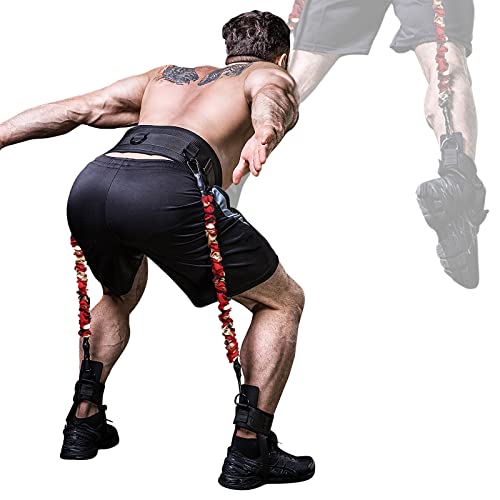
Safety First - Don't worry about tripping over the box, overcome psychological fear. Easy storage and portability, making it a convenient addition to any home gym or workout spa

Durable Construction: Made from high-quality wood, this plyo box is built to last and withstand intense workouts, ensuring long-term use for your fitness routines

Multiple Sizes: Choose the right exercise tool for your needs and enhance your training with different height settings. Suitable for all levels, from beginners to professionals, this plyo box is perfect for home gym setups.
Recent Posts

How to Keep Volleyball Fun for the Whole Family
How to Support a Sensitive or Perfectionist Player
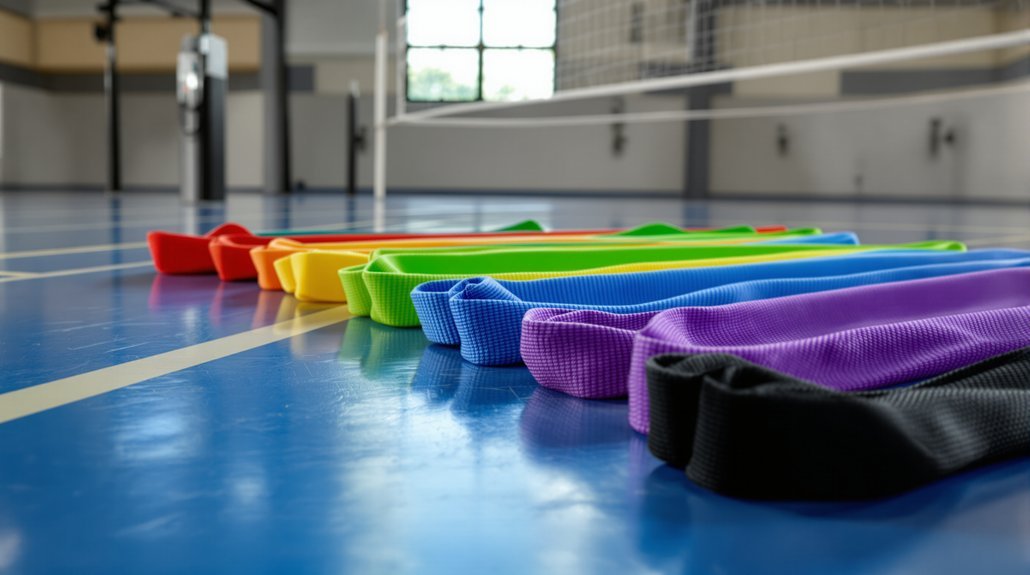
7 Best Resistance Bands for Volleyball
Frequently Asked Questions
What Is the Role of the Outside Hitter?
As an outside hitter, you’re your team’s go-to attacker, receiving about 60% of sets. Your swing mechanics must convert even off-target passes into kills. You’ll need solid court awareness to read blockers and find open spots.
In the back row, your defensive coverage keeps rallies alive through quality digs and serve-receive passes. You’ll play all six rotations, so stamina and versatility matter. It’s a demanding but rewarding position.
Where Do You Put the Weakest Player in Volleyball?
You’ll typically place your weakest player in position 1 (back-right) during serve receive, where they’ll handle fewer passes.
A smart rotation strategy keeps them away from primary attackers. If they struggle defensively, substitute in a defensive specialist when they rotate to the back row.
Position them opposite your strongest passer so teammates can cover their weaknesses. This approach minimizes exposure while keeping your lineup competitive.
Is Outside Hitter a Good Position?
Yes, outside hitter is a great position if you’re versatile. You’ll handle about 60% of your team’s sets, making you the primary scoring threat.
Your passing strategy directly impacts offensive flow since you’re in serve-receive. Rotation adaptability matters because you’ll attack, block, and defend across all six positions.
You’ll also work various attacking angles from the left side, keeping defenses guessing.
What Is the Hardest Position to Play in Volleyball?
Most players and coaches consider setter the hardest position in volleyball.
You’re making split-second decisions on every play while placing the ball precisely for your hitters.
The physical demands are real, but the mental toughness required sets this role apart.
You won’t need the defensive range of a libero, but you’ll orchestrate every offensive play—that’s serious pressure.
Bottom Line
You’ve now got a solid understanding of what makes the outside hitter such a demanding role. It’s not just about powerful kills—you’re expected to pass, block, and lead on the court. Focus on developing your all-around game rather than just your swing. Practice serve-receive daily, communicate constantly with your setter, and study opposing blockers. With consistent work, you’ll become the reliable playmaker every team needs.