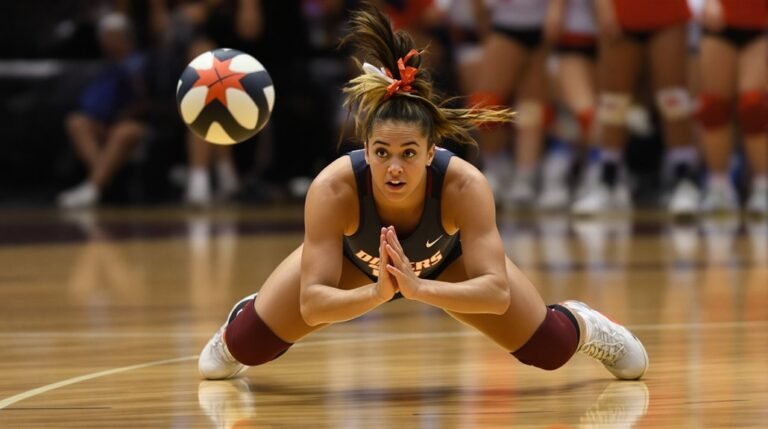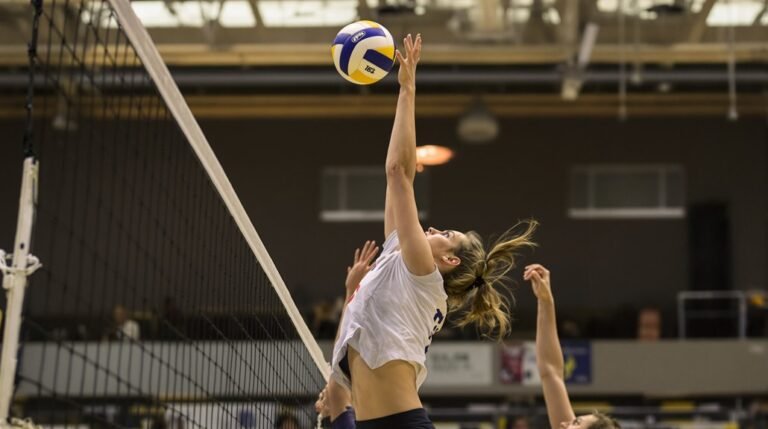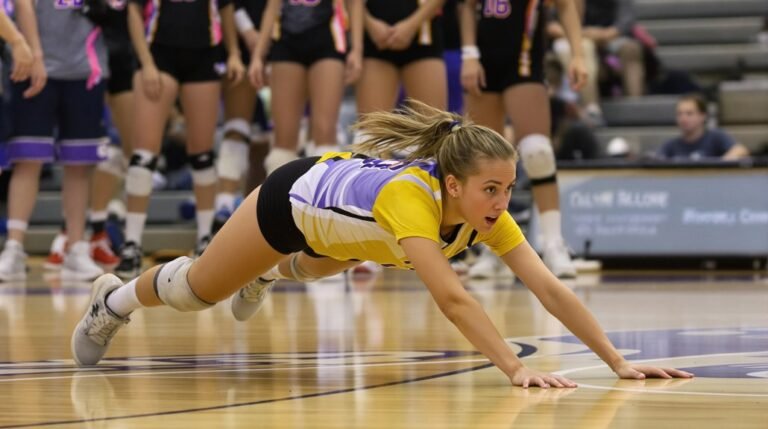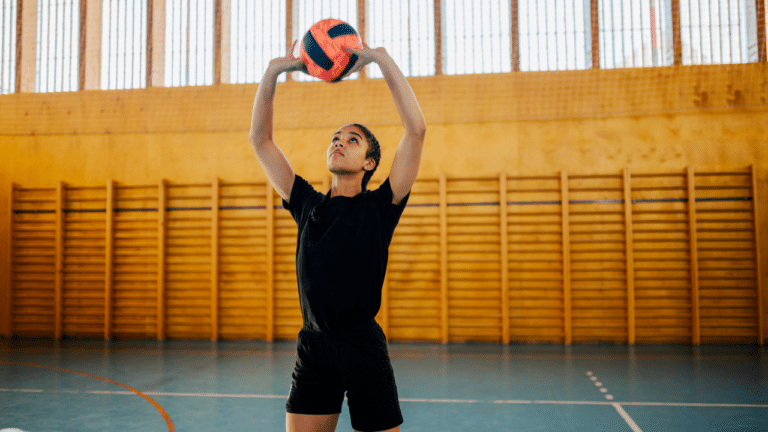


If you’ve ever watched a volleyball match and noticed one player swinging hard from the right side while also anchoring the block, you’ve spotted the opposite hitter. This position carries serious responsibility—you’re expected to handle a heavy volume of attacks, shut down opposing outside hitters at the net, and stay ready when plays break down. Understanding what makes this role unique starts with breaking down its core duties.
Key Takeaways
- The opposite hitter plays right-side position 2, lining up directly across from the setter in the rotation.
- They serve as the team’s secondary primary attacker, handling 15–25 attack attempts per set from right-side and back-row positions.
- They block opposing outside hitters and form double-block partnerships with the middle blocker to seal cross-court angles.
- The opposite hitter stays out of serve receive rotations, remaining available for quick offensive opportunities and out-of-system sets.
- They function as the emergency setter when the primary setter digs the first ball, keeping plays alive.
What Is a Right-Side/Opposite Hitter in Volleyball?
The right-side hitter, also called the opposite hitter, lines up directly across from the setter in the rotation and attacks primarily from the right side of the court. You’ll find this player serving as your team’s secondary primary attacker, handling high-velocity sets with power and precision.
What makes this position unique? The opposite hitter doesn’t serve receive, which keeps them available for quick offensive opportunities. They’re responsible for back-row attacks like pipes and D-balls, adding another scoring threat from deep in the court.
Defensively, you’ll see them block against outside hitters on the opposing team. They’ve also got to stay ready as an emergency setter when the primary setter digs the first ball. It’s a demanding role requiring true versatility.

Primary Responsibilities on Offense
Now that you understand what makes this position unique, let’s look at what opposite hitters actually do when their team has the ball. As the primary attacker, you’ll handle a significant volume of swings each match—often 15-25 attack attempts per set.
The opposite hitter is your team’s offensive workhorse, shouldering 15-25 attack attempts every single set.
Your main offensive responsibilities include:
- Attacking the ball from right-side positions when the setter delivers quick, high sets near the antenna
- Hitting back-row attacks (pipe or D-ball) to maintain offensive options when you’re rotating through the back court
- Serving as the emergency setter when your setter takes the first touch, keeping plays alive with a playable second contact
You’ll frequently receive out-of-system sets when passes go sideways. This role spreads opposing blockers and opens lanes for teammates.
Blocking Duties and Defensive Contributions
Standing at the net as an opposite hitter means you’ll face the opposing team’s outside attacker—typically their go-to scorer on high-pressure points.
Your right-side blocking position puts you directly across from their left-side weapon, so you’ll need sharp block timing to shut down their best swings.
You won’t block alone. You’ll form a double-block partnership with your middle blocker, working together to seal seams and cut off cross-court angles.
Read the setter’s shoulders and the hitter’s approach to anticipate where the ball’s going.
In back-row defense, your job shifts to digging hard-driven balls and covering tips off your own block.
Quick shifts matter here—you’ll move from blocking to defensive positioning in seconds.
Teams sometimes substitute a defensive specialist for you in back-row rotations.


Reliable Dimensions for Training: the diameter of the volleyball training mat is about 11.81 inch and the thickness is about 2 inch, these volleyball pads for training are devised to enhance the precision and power of your volleyball plays; Their size allows easy handling and maximum maneuverability, providing user-friendly experience for both professional players and apprentices

Complete and Considerate Combination for You: you will receive 1 set of volleyball training equipment, including 1 piece of elastic volleyball resistance belt, 1 pair of setting hand straps, 1 pair of volleyball knee pads, 1 pair of volleyball arm sleeves and 1 piece of drawstring backpack; Abundant quantity and thoughtful accessories can efficiently satisfy your various needs

CONTROLLED BLOCKING: Tandem Sport Volleyball Quad Blocker consist of four units that secure to the net to provide a controlled block
Court Positioning in Front Row and Back Row
Because your role shifts dramatically based on rotation, understanding court positioning helps you maximize your impact in every phase of play.
As a right-side hitter in the front row, you’ll set up near the right antenna at position 2. Here’s what you’ll focus on:
- Form a double block with your middle blocker against the opponent’s outside hitter
- Time your jumps precisely for high outside sets coming your way
- Execute quick right-side swings or slides on tight sets near the net
When you rotate to the back row, your responsibilities change. You become a back-row attack threat from position 1 or 6, running pipes or D-balls.
Many coaches use a serve-receive substitution here, bringing in a defensive specialist while keeping you fresh for attacking duties when you return to the front row.
Essential Skills for Right-Side Hitters
Knowing where to stand on the court only matters if you’ve got the skills to back it up.
As an opposite hitter, you’ll need to master several core abilities. Your blocking technique must be sharp enough to shut down the opponent’s outside hitter—coordinate your hand placement and timing with your middle blocker to close gaps along the net.
You’ll attack high sets from the right-side cone, generating spike velocities that can exceed 70–80 km/h at elite levels. Back-row hitting from positions 5 and 6 keeps you dangerous in every rotation.
Emergency setting matters too; when your setter takes the first contact, you’ll deliver quick, accurate push sets. Strong serve receive positioning and smart shot selection round out your game.
A solid vertical jump, built through 2–3 weekly plyometric sessions, powers everything.

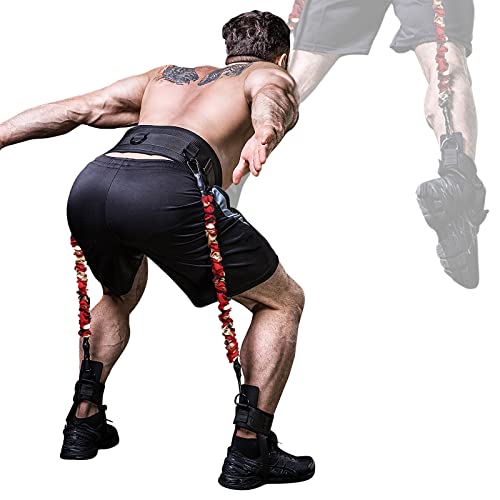
Safety First - Don't worry about tripping over the box, overcome psychological fear. Easy storage and portability, making it a convenient addition to any home gym or workout spa
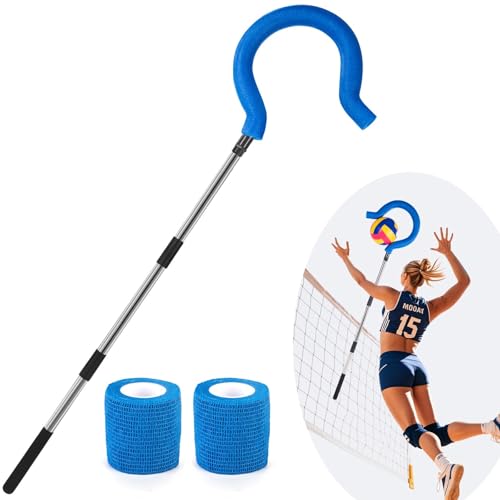
Professional Design for All Levels: This volleyball spike trainer (Patent pending) helps beginners and experienced players practice spiking, approach timing, arm swing and jump training; the question mark hook holds a real ball at a consistent contact point for focused hitting drills

Complete Volleyball Training Equipment: This all-in-one package includes a Pouch, perfected Waistband, improved Elastic Cord, upgraded Hand Straps, larger Drawstring Backpack and Gift Box, making it a great Volleyball gift.
How the Opposite Hitter Supports Team Balance
A well-rounded offense doesn’t lean too heavily on one side, and that’s exactly where you come in as the opposite hitter. By attacking consistently from the right-side, you balance the offense and force blockers to respect both pins equally. Your back-row attacks, including pipes and D-balls, spread blocking pressure across the entire net.
Here’s how you support team balance:
- You stay out of serve-receive rotations, keeping yourself available for quick shift swings when passes go sideways.
- As the primary blocker against the opponent’s outside hitter, you anchor the right side and free your middle to roam.
- When the setter takes the first pass, you step in as an emergency setter to keep the offense moving.
Back-Row Attack Capabilities
Your front-row contributions only tell part of the story—back-row attacks let you stay dangerous even after rotating behind the 3-meter line.
As an opposite hitter, you’ll typically execute attacks from zone 6 (the pipe) or zone 1 (the D-ball). These options give your setter a third attacking choice and force opposing blockers to respect threats from multiple locations.
Since you usually skip serve-receive duties, you’re free to focus entirely on hitting. This advantage means more back-row swings per rotation.
However, success requires approach adjustments—shorter steps and modified arm mechanics generate power while staying legal. Your jumping ability matters here too. Back-row attacks add significant jump volume to your workload, so strong lower-body power and endurance keep you effective throughout the match.
Training Tips for Aspiring Opposite Hitters
Because the opposite position demands such a wide skill set, your training plan needs to cover multiple areas without neglecting any single one.
Training the opposite position means developing every skill in your arsenal — neglect one area and your game will suffer.
As an aspiring opposite hitter, you’ll want to structure your weekly routine around these core priorities:
- Approach and arm-swing drills – Spend 20–30 minutes, three times per week, practicing weighted combinations from zones 2 and 1 to sharpen your right-side attack timing.
- Vertical jump development – Add targeted plyometrics and lower-body strength exercises like squats, Bulgarian split squats, and box jumps 2–3 times weekly to gain 4–8 inches over 12–16 weeks.
- Blocking timing sessions – Dedicate 10–15 minutes per practice to closing seams and reading setter cues with your middle blockers.
Don’t skip emergency-setting reps or back-row attack work for pipe/D-ball consistency either.
Notable Right-Side Hitters in Professional Volleyball
When you watch elite-level volleyball, certain opposite hitters stand out for their ability to dominate matches from the right side. Maxim Mikhaylov of Russia earned Olympic gold in 2012 and MVP honors at the 2011 FIVB World Cup. His scoring efficiency and attack attempts consistently rank among the highest in international competition.
Matt Anderson has been a reliable right-side threat for the U.S. national team, contributing to their 2016 Olympic bronze medal.
On the women’s side, Annie Drews showcases exceptional blocking and attacking skills. She earned MVP at the 2019 FIVB Volleyball Nations League.
These players share common traits: they lead their teams in points per match and maintain impressive hitting percentages. Studying their techniques can help you understand what elite opposite hitter performance looks like.
Recent Posts

Sideline Behavior: How Not to Embarrass Your Player
ASICS Men’s Gel-Rocket 11 Volleyball Shoes

How to Keep Volleyball Fun for the Whole Family
Frequently Asked Questions
What Is the Role of the Opposite Hitter in Volleyball?
As an opposite hitter, you’re your team’s secondary scoring threat, attacking from the right antenna with powerful swings.
Your attack strategy focuses on high-velocity sets while your blocking technique targets opposing outside hitters.
You’ll handle rotation responsibilities that keep you available for momentum offense since teams often spare you from serve-receive.
Your defensive positioning, serving impact, and communication leadership all boost scoring efficiency.
You’re the reliable option when plays break down.
Where Do You Put the Weakest Player in Volleyball?
You’ll typically place the weakest player in a back-row position, usually right-back or left-back. This defensive positioning keeps them away from blocking duties while they focus on skill development through serve placement and digging.
Your rotation strategy should use substitution timing to swap them out before they reach the front row. Communication drills and motivation techniques help build confidence, while smart bench psychology makes certain they’re contributing without feeling sidelined.
What Does a Rightside Do in Volleyball?
As a right-side hitter, you’ll attack from the right front and back row, often becoming your team’s scoring option when plays break down.
Your blocking assignments focus on stopping the opponent’s outside hitter, requiring solid blocking techniques and timing with your middle.
You’ll master specific footwork patterns for quick attack tempo, practice shift drills moving from defense to offense, and develop smart shot selection.
Your defensive positioning keeps you ready for back-row attacks.
What Is the Purpose of a Libero?
A libero is a defensive specialist who wears a different-colored jersey per uniform regulations. You’ll see them handle serve receive and back row coverage without counting against substitution limits—that’s one of their key rotation exceptions.
Their passing technique keeps the offense running smoothly. Watch for libero signals they use to communicate with teammates.
Many take on a leadership role, directing traffic and reading hitters to boost your team’s defensive success.
Bottom Line
Now you’ve got a clear picture of what makes the opposite hitter such a valuable position. You’re expected to deliver powerful attacks from the right side, anchor your team’s blocking against outside hitters, and stay ready for back-row offense. It’s a demanding role that requires both physical strength and smart court awareness. Focus on your approach footwork and blocking timing first—those fundamentals will set you apart.