


You’ve probably watched your child hesitate before a serve or slump after a missed dig, and you know that technical skill alone won’t unleash their full potential on the court. Confidence in volleyball isn’t about empty praise or waiting for big wins—it’s built through deliberate daily habits that give young athletes a sense of control and measurable progress. The strategies that follow will show you exactly how to create that foundation.
Key Takeaways
- Set small, achievable goals with measurable benchmarks and increase difficulty by 10–15% once 90% success is reached.
- Track progress through practice journals documenting three observations per session: one skill improved, one challenge, one future goal.
- Use monthly video comparisons to provide visual proof of technical improvements in serving, footwork, and arm swing.
- Replace negative self-talk with positive affirmations and constructive alternatives like “I’m learning this skill” instead of “I can’t.”
- Practice daily five-minute visualization sessions rehearsing successful plays and recovery from mistakes to build mental confidence.
Set Small, Achievable Goals That Build Over Time
When building your child’s volleyball confidence, small wins create momentum that translates into lasting improvement. Start with micro goal sequencing—breaking complex skills into manageable steps your child can master progressively. For example, set a target of making 8 out of 10 float serves consistently in practice before advancing to more challenging scenarios. These measurable benchmarks provide clear success markers that show tangible progress.
Work with your child’s coach to establish weekly objectives, like achieving 5 successful passes to the setter out of 10 game attempts. Track progress visually using charts that document improvement over time. When your child consistently hits 90% success on a specific skill, increase difficulty by 10-15%. Celebrate each milestone, no matter how minor it may seem, to reinforce positive momentum and acknowledge the effort invested. This systematic approach guarantees confidence builds on demonstrated competence rather than wishful thinking.

Develop a Growth-Oriented Mindset
Because your child’s beliefs about their athletic potential directly shape their volleyball development, cultivating a growth-oriented mindset becomes one of your most powerful parenting tools.
Your beliefs about your child’s athletic potential become self-fulfilling prophecies that directly shape their actual volleyball development.
Help them embrace mistakes as essential learning opportunities rather than threats to their competence. When they miss a serve, frame it as valuable feedback about technique adjustments needed.
Encourage challenge seeking by praising their willingness to attempt difficult skills, not just successful outcomes. Research shows athletes who view setbacks as growth opportunities demonstrate 45% higher long-term improvement rates.
Create accountability through practice journals where they document attempts and lessons learned.
Remind them that building volleyball skills requires consistent repetition over weeks, with neural pathways physically strengthening through focused practice. Understanding this biological reality helps them persist through inevitable plateaus. Consider pairing your child with a teammate who can provide supportive, specific feedback during practice sessions when coaches may be attending to others.
Use Visualization and Mental Preparation Techniques
Beyond physical practice on the court, your child can strengthen volleyball skills through structured mental rehearsal that activates the same brain patterns used during actual play. Research shows visualization combined with physical training improves performance more than practice alone.
Guide your child to create detailed mental scenes including court appearance, opponents, and specific plays. Multi sensory rehearsal—incorporating sight, sound, and touch—makes these mental scenarios more realistic and effective.
Encourage daily five-minute visualization sessions before training, using both internal perspective (seeing through their own eyes) and external perspective (watching themselves perform). Include pressure simulation practice by mentally rehearsing high-stress situations like game-point serves or pivotal blocks. Mental preparation helps athletes bounce back from mistakes by rehearsing recovery scenarios and positive responses to setbacks. This mental preparation strengthens neural pathways, builds confidence, and conditions your child to respond calmly during actual competition.

Foster Positive Self-Talk and Communication
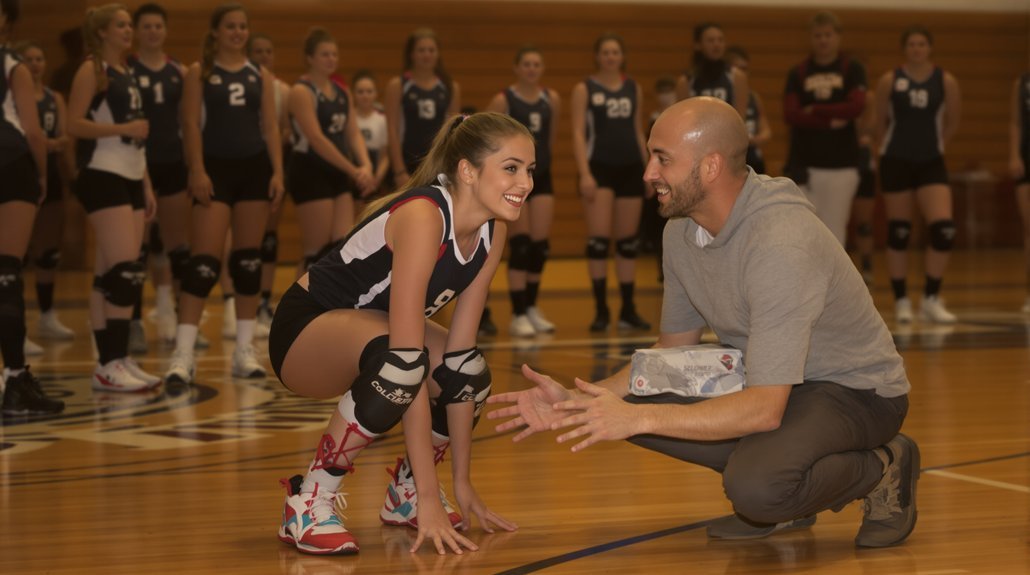
While mental imagery prepares your child’s mind before stepping onto the court, the internal dialogue they maintain during practice and competition shapes how they respond to every serve, spike, and stumble.
Help them develop affirmation scripts like “I am prepared and ready” or “I trust my training” that reinforce capabilities before games.
During play, teach silent cues such as “Next play” or “Reset now” to recover quickly from errors.
Replace phrases like “I can’t” with constructive alternatives: “I will try” or “I’m learning this skill.”
After practice, ask your child to identify three things they performed well. This reflection builds self-efficacy while establishing positive thought patterns.
When mistakes happen, encourage future-focused language: “I’ve got the next one” instead of dwelling on what went wrong.
Consider having your child keep a journal of negative thoughts that arise during practices or games, noting what was happening and how each thought felt, so you can work together to identify and challenge recurring patterns.
Create a Supportive Team Environment
Your child’s confidence doesn’t develop in isolation—it flourishes when the entire team creates an atmosphere where athletes feel valued, heard, and supported.
Strong teams implement team rituals like structured shout-outs after practice, specifically acknowledging effort metrics rather than just wins. These celebrations reinforce positive behaviors and create psychological safety.
Role clarity strengthens this foundation markedly. When your child understands their specific position responsibilities and how they contribute to collective success, anxiety decreases and confidence grows.
Encourage coaches to involve athletes in setting team objectives—this ownership increases commitment by 40% according to sports psychology research. Coaches who recognize excellence in specific behaviors—like a well-executed dig or supportive communication—help players develop positive self-image that drives their external performance on the court.
Look for programs establishing peer mentorship systems and rotating leadership roles during warm-ups. These practices distribute responsibility across all players, helping every athlete develop leadership skills while building trust throughout the roster.

Focus on Controllable Factors During Practice and Play
Among the most powerful confidence-building strategies, directing your child’s attention toward controllable factors transforms volleyball from an anxiety-producing performance into a series of manageable actions. Help them focus on execution elements like maintaining a consistent toss height, completing their pre-serve routine with three ball bounces, and landing in balanced positions after each movement. These physical actions remain within their control regardless of score or opponent skill level.
Teach your child to replace outcome thoughts (“I need to ace this”) with process cues (“contact point at two o’clock”). When mistakes occur, implement a 15-second reset routine: bounce the ball twice, take one deep breath, and return to ready position. This structured approach builds confidence through repetition of controllable behaviors rather than worrying about uncontrollable results. Encourage your child to maintain consistent effort in every practice, game, and team event, as this work ethic strengthens their foundation for individual confidence.
Track Progress Through Journaling and Video Review
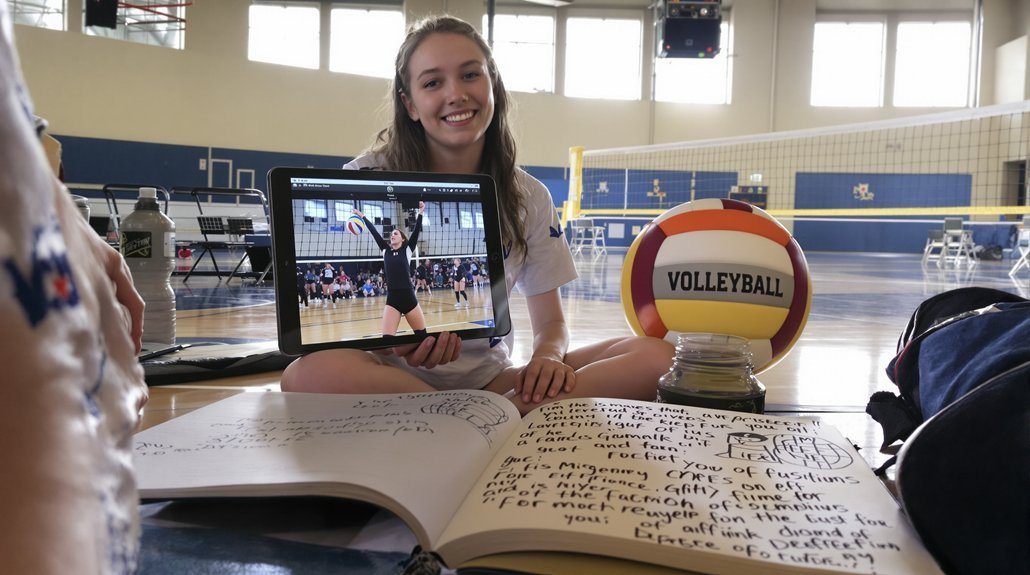
Through consistent documentation of your child’s volleyball development, you’ll create powerful evidence of improvement that builds genuine confidence.
Progress journals help young athletes track specific achievements, like increasing their serve accuracy from 60% to 75% over six weeks. Encourage your child to record three observations after each practice: one skill they improved, one challenge they faced, and one goal for next session. Written reflection enhances retention and motivation by helping players internalize lessons from each training session.
Complement written tracking with monthly video comparisons. Recording your child’s serving form in September and comparing it to December footage provides undeniable visual proof of technical advancement.
These side-by-side reviews reveal improvements in footwork, arm swing, and follow-through that might otherwise go unnoticed. This combined approach transforms abstract progress into concrete, measurable achievements your child can see and celebrate.
Celebrate Effort and Personal Improvement
The most powerful confidence-building strategy in youth volleyball consistently focuses attention on effort rather than scoreboard results. You’ll build authentic self-assurance by recognizing skill specific praise like “your arm swing extension improved contact on that third serve” instead of generic “good job” comments. Track effort milestones such as attempting 15 blocks during practice or maintaining focus through a complete 30-minute defensive drill.
When your daughter makes seven successful first-tempo sets during scrimmage, quantify that achievement. Replace corrections with positive directives: “keep your elbow high” works better than “don’t drop your elbow.”
Frame home discussions around enjoyment and individual skill progression rather than win-loss records. Ask improvement-focused questions like “Which defensive position felt strongest today?” to guide self-evaluation of specific technical gains. Help your child write down negative thoughts that arise during matches and replace them with positive alternatives to build a mental habit of rejecting anxiety-producing self-statements.
Frequently Asked Questions
Recent Posts
How Do I Handle My Child’s Confidence After Being Benched or Cut?
Help your child through positive reframing by treating benching as a development opportunity rather than failure. This approach reduces performance anxiety by 35% when they return to play.
Focus on goal resetting with specific, achievable targets during this period. Encourage them to continue training—athletes who stay active recover confidence 40% faster than those who disengage.
Implement a progress journal to track improvements, which builds resilience in 89% of athletes facing setbacks.
What Should I Do When My Child Compares Themselves to Teammates?
Help your child shift their attention by praising effort over outcomes.
When they mention teammates’ abilities, redirect the conversation to their own improvement.
Set goals based on personal development—like mastering three better serves this week—rather than competing with others.
Encourage them to track their individual progress through a simple journal.
This approach builds sustainable confidence rooted in self-improvement rather than comparison, helping them stay focused on what they can control.
How Can I Help My Child Recover From a Major Mistake?
First, acknowledge feelings by validating their disappointment without dwelling on the error.
Then focus process by helping them establish a quick reset routine—perhaps five seconds of intentional breathing or a cue phrase like “next ball.”
Encourage them to use tactile cues such as touching their fingertips together to signal mental reset.
Practice this routine during training so it becomes automatic during matches when mistakes inevitably happen.
Should I Attend All Games or Does That Increase Pressure?
You don’t need to attend every game—research shows moderate involvement works best. Attend selectively, perhaps 60-70% of matches, to demonstrate support without creating performance anxiety.
Your constant presence can unintentionally signal that every game carries high stakes. When you do attend, focus on unconditional support rather than outcomes. This presence balance helps your child enjoy volleyball while developing intrinsic motivation and confidence independent of your watchful eye.
When Should I Consider Getting a Sports Psychologist Involved?
Consider involving a sports psychologist when your child shows persistent performance blocks despite physical readiness, expresses wanting to quit despite ability, or displays ongoing anxiety affecting their game.
Warning signs include unexplained performance declines, difficulty managing competition pressure, or social withdrawal from teammates.
Research shows 65% of volleyball players reach better performance peaks and develop stronger mental resilience with proper psychological support, making early intervention valuable for long-term development.
Bottom Line
Building volleyball confidence takes consistent effort across several areas. You’ve learned how goal-setting, growth mindset, visualization, positive self-talk, team support, controllable focus, progress tracking, and celebrating improvement all work together. Start with one or two strategies that fit your child’s needs best, then add more over time. Small changes in how you approach practice and games will create lasting confidence that extends beyond the court.