

You’ve probably seen it happen: one family member spikes the ball with authority while another struggles to make contact, and suddenly the fun drains from the game. The gap between skill levels can turn what should be quality time into frustration for everyone involved. But volleyball doesn’t have to divide your family by ability—with a few smart adjustments to rules, equipment, and expectations, you’ll create an experience where each person contributes and genuinely enjoys playing together.
Key Takeaways
- Use scaled courts (7m x 14m) and adjustable nets to match skill levels and increase success rates for all ages.
- Choose softer, lighter balls and progressive formats like Blanket Volleyball to reduce difficulty and build confidence gradually.
- Celebrate effort and improvement over winning; rotate positions regularly so everyone experiences different roles without judgment.
- Incorporate team-building activities like setting relays, obstacle courses, and social events to strengthen family bonds beyond gameplay.
- Enjoy health benefits together: 30 minutes burns up to 178 calories while reducing stress and building lifelong activity habits.
Choose the Right Volleyball Format for Your Family’s Skill Levels
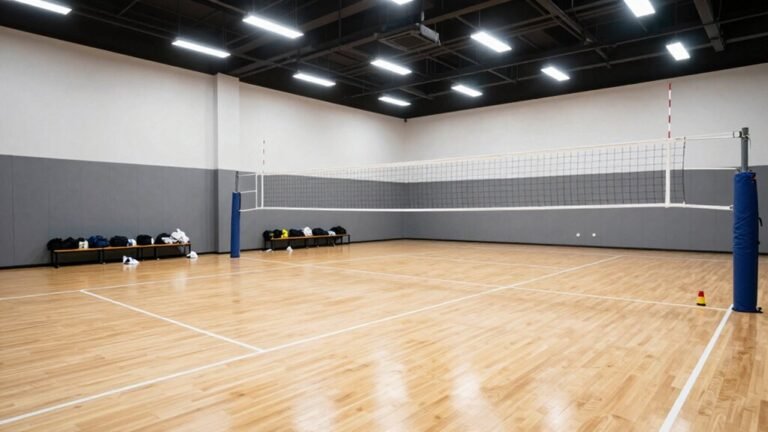
Too often, families struggle to enjoy volleyball together simply because they’re using the wrong format for their mixed skill levels. Start by selecting scaled courts that match your family’s abilities. A 7m x 14m court increases success rates to approximately 70% for developing players, making rallies more achievable and enjoyable. You can even use badminton court dimensions for younger children.
Next, implement progressive rules that build confidence gradually. Blanket Volleyball eliminates complex hand techniques entirely, while the Tripleball system maintains three-contact rallies with structured skill development. Beach Ball Volleyball offers another excellent option, using larger, lighter balls that reduce difficulty. The key is matching your format to your family’s current abilities, then advancing as skills improve.
For added excitement, try Half Court Round Robin with teams of 2–3 family members playing first-to-10 matches on a court split down the middle. The key is matching your format to your family’s current abilities, then advancing as skills improve.

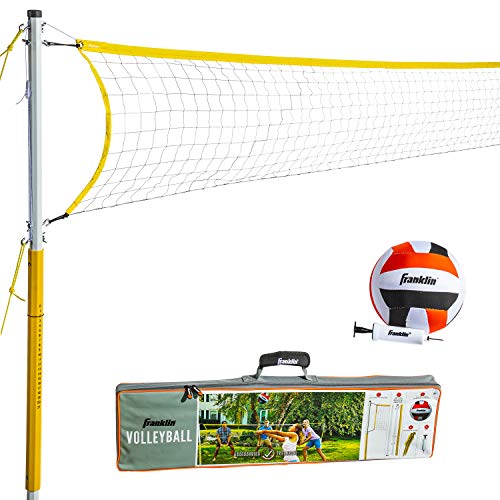
FUN FOR EVERYONE: This go-to, complete volleyball set is a perfect gift for that can be enjoyed by all for unforgettable outdoor fun

Choose the Right Size for Your Space: Available in 20FT and 32FT options for different outdoor areas. The 20FT net is ideal for smaller backyards, family games and casual play, while the 32FT net provides more space for larger yards, parks and group activities. The 32FT set includes a boundary line for court marking; the 20FT set does not include a boundary line. Please measure your setup area before ordering.

3-In-1 Multisport Net: Switch heights for Volleyball (7.4’), Badminton (5.1’), or Pickleball in seconds! Includes a 17ft net, 4 rackets, 3 shuttlecocks, a volleyball, and a pump (Paddles not included). One versatile set for all backyard fun
Create a Supportive Environment Where Everyone Feels Welcome
When your family gathers to play volleyball, the emotional atmosphere matters just as much as the physical setup. Creating psychological safety means everyone can participate without fear of judgment or criticism. Research shows that autonomy-supportive approaches lead to positive long-term development in sports. Here’s how to build that welcoming environment:
- Celebrate effort over outcomes – Praise hustle and improvement rather than only successful plays
- Rotate positions regularly – Give everyone chances to try different roles without pressure
- Encourage autonomy in decision-making during play
- Set age-appropriate expectations – Remember that confidence drops 30% for girls aged 8-14, requiring extra support
Let family members make active choices about their involvement. This moderate approach, combined with your consistent support, helps everyone develop skills while genuinely enjoying the game together. Programs emphasizing positive interpersonal relationships among participants create stronger foundations for continued engagement and skill development.
Adapt Equipment and Space to Fit Your Family’s Needs
Scaling down your volleyball setup opens the game to family members of all ages and abilities.
Adjustable nets accommodate players of varying heights, letting you modify the height based on who’s playing.
You can purchase portable systems with ground stakes for outdoor use or wall-mounted options that fold away when not in use.
These space-saving solutions work particularly well for families with limited play areas.
DIY equipment offers budget-friendly alternatives.
PVC pipes create affordable net poles, while cardboard boxes and leaf blowers transform into creative launching mechanisms.
Heavy wood pieces serve as stable bases for homemade net systems.
You can even hang sheets from the net top to create “blind volleyball” variations.
A momentary footswitch paired with assistive equipment allows players with mobility limitations to activate ball-launching devices independently.
Consider softer volleyballs with enhanced control for younger or developing players, reducing impact force while maintaining durability.


Choose the Right Size for Your Space: Available in 20FT and 32FT options for different outdoor areas. The 20FT net is ideal for smaller backyards, family games and casual play, while the 32FT net provides more space for larger yards, parks and group activities. The 32FT set includes a boundary line for court marking; the 20FT set does not include a boundary line. Please measure your setup area before ordering.

Strong & Durable: Crafted with premium high-density nylon mesh, sturdy powder-coated iron tubing, and reinforced PE connectors. Includes 4 ground stakes for wind resistance on grass or sand. Designed for both indoor and outdoor use—simply store in the carry bag after play to protect against weather and prolong its lifespan

Professional 12FT Volleyball Net: Designed with input from professional athletes, the MangoStar 12×8ft volleyball net delivers exceptional quality and training performance. Ideal for one-on-one drills or two-on-two competitive matches, it supports diverse training needs with reliability
Focus on Health Benefits While Keeping Competition Light
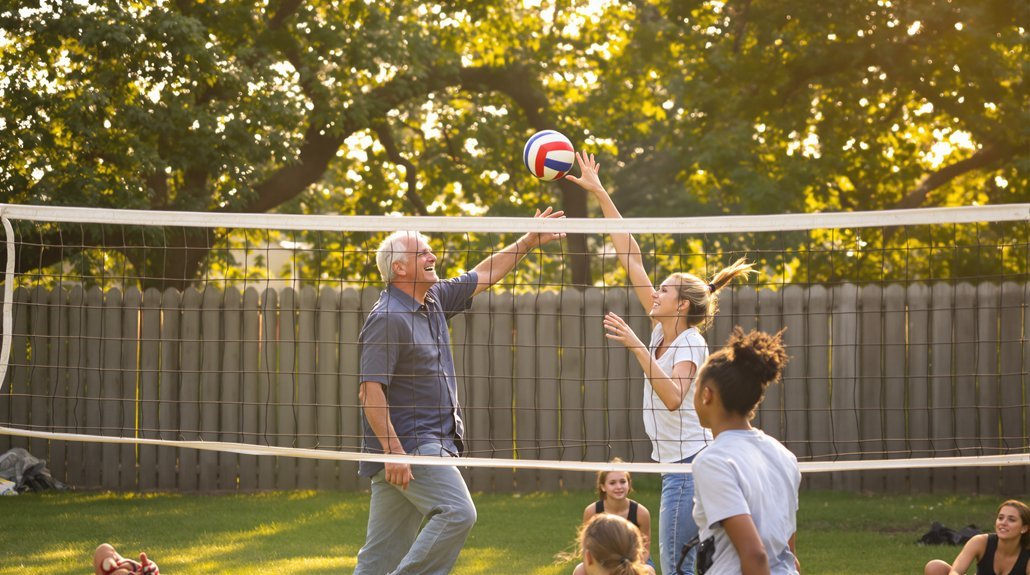
Beyond the enjoyment of playing together, family volleyball delivers substantial health benefits that don’t require intense competition.
Family volleyball transforms fitness into fun, delivering meaningful health benefits for all ages without the pressure of competitive play.
You’ll burn 90-178 calories in just 30 minutes while building cardiovascular strength equivalent to jogging a mile. The cardio benefits strengthen your heart and reduce risks of chronic conditions like heart disease and diabetes.
Perhaps most valuable are the mental health improvements:
- Reduced stress, anxiety, and depression through physical activity
- Improved sleep patterns essential for cognitive function
- Boosted self-confidence through skill development
- Enhanced mental resilience that transfers to daily challenges
Family sports training shows measurable increases in happiness levels after just eight weeks. When you emphasize these wellness gains over winning, everyone develops healthier habits without pressure. Your children become eight times more likely to stay active into adulthood.
The game naturally improves coordination, balance, and speed as players practice serving, passing, and setting throughout each match.
Build Lasting Connections Through Team-Oriented Activities
While individual skills matter in volleyball, the strongest family teams emerge through activities that prioritize collaboration over solo achievement. Trust exercises like back-lying balloon volleyball require complete reliance on teammates, developing communication skills while everyone laughs together. Shared rituals create lasting bonds—consider establishing “Pizza Friday” after practice or organizing monthly beach volleyball outings where skill levels don’t matter.
Team-Building Activities That Strengthen Family Bonds
| Activity Type | Family Benefit |
|---|---|
| Setting relays | Tests coordination while building friendly competition |
| Self-bumping competitions | Creates personal goals within team context |
| Air Express challenges | Requires cooperation using beach balls and inner tubes |
| Obstacle courses | Develops strength through playful challenges |
| Secret Santa exchanges | Builds connections beyond the court |
Teams that communicate more play freer and recover faster from mistakes. Organizing offseason social events like game nights or group hikes helps maintain the daily team interactions that strengthen family volleyball communities year-round.

Frequently Asked Questions
What Age Should Children Start Playing Volleyball With the Family?
You can start your children with early introduction to volleyball as young as age 3-5 using modified games and oversized soft balls.
Parent participation makes sessions more engaging during these foundational years.
Around age 7, kids develop sufficient attention spans for 30-45 minute family games with proper techniques.
The ideal age for structured family play is 10-12, when children grasp strategies and maintain interest through full 60-minute sessions.
How Often Should Families Play Volleyball to See Fitness Benefits?
You’ll see noticeable fitness benefits with 2-3 weekly sessions lasting about two hours each.
Research shows twice weekly matches deliver significant cardiovascular improvements and physical development within just eight weeks. This consistent schedule strengthens your heart, improves circulation, and builds muscle endurance.
Most families observe measurable improvements in both physical fitness and mental energy within a few months of maintaining this regular practice routine.
What Is the Standard Size for an Indoor Volleyball Court?
You’ll find standard indoor dimensions measure 18 meters long by 9 meters wide, creating a 531-square-meter playing surface.
The court divides into two equal 9×9-meter halves separated by the net.
For men’s competition, net height sits at 2.43 meters, while women’s nets measure 2.24 meters.
You’ll also need to account for the free zone—typically 3 meters minimum around the court’s perimeter for safe play.
Recent Posts

ASICS Men’s Upcourt 6 Volleyball Shoes

How to Manage Homework & Schoolwork During Volleyball Season
Preventing Common Volleyball Injuries
Do Girls Participate in Volleyball More Than Boys?
Yes, girls participate in volleyball far more than boys.
Recent data shows 492,799 girls played high school volleyball compared to just 50,353 boys—nearly a 10:1 ratio.
These gender trends reflect historical participation barriers, as boys’ programs remain less available nationwide.
However, boys’ participation has grown 40% since 2017, suggesting increasing opportunities.
Girls’ volleyball ranks as the second most popular high school sport for female athletes after track and field.
How Many Players Are Typically on a Volleyball Team Roster?
Your team’s roster size depends on the level you’re playing.
High school varsity teams typically carry 10-14 players, with twelve being ideal.
College programs operate under NCAA roster limits of eighteen players maximum.
Recreational adult leagues usually maintain 12-14 players for substitution flexibility.
Beach volleyball differs entirely, requiring just two players per team.
USA Volleyball sets general roster limits at fifteen players for competitive events.
Bottom Line
Family volleyball thrives when you prioritize inclusion over perfection. By adjusting rules, rotating positions, and celebrating everyone’s progress, you’ll create a game that fits your crew. Mix competitive rallies with cooperative challenges, keep sessions under an hour, and add simple rituals like post-game snacks. These small adjustments transform volleyball from a sport into a shared experience that strengthens bonds and keeps everyone coming back for more.