


You’ve just watched your child’s team lose in five sets, and the car ride home feels heavy with silence. Or maybe they won big, and you’re wondering whether to celebrate or worry about next week’s tougher opponent. Either way, how you respond in these moments shapes more than just their volleyball skills—it builds resilience, confidence, and their relationship with competition itself. The approach you take now determines whether wins and losses become stepping stones or stumbling blocks.
Key Takeaways
- Cheer for effort, teamwork, and daily progress rather than scoreboard outcomes to build lasting confidence regardless of results.
- Review game footage within 48 hours, focusing on 2–3 specific skills to turn losses into learning opportunities.
- Wait 24 hours before discussing emotionally charged topics like playing time to allow calmer, more productive reflection.
- Manage sideline emotions through deep breathing and positive body language, as your reactions directly affect your child’s performance.
- Encourage interests beyond volleyball to preserve balanced identity and reduce mental health risks during setbacks or injuries.
Cheer for Effort and Team Play, Not Just Points on the Scoreboard
Too often, parents in the stands focus exclusively on the scoreboard while their children desperately need recognition for the effort they’re putting forth. Research shows youth athletes want 40% more praise and understanding than directive comments. When you shift your attention from points to process praise, you’ll see remarkable changes. Athletes receiving effort-focused feedback develop 21% higher self-esteem and demonstrate greater resilience when facing setbacks.
Instead of celebrating only scoring plays, acknowledge your child’s defensive saves, accurate passes, and communication with teammates. This team effort recognition develops critical social skills in 89% of youth volleyball participants. Parents emphasizing collaboration report 37% higher satisfaction among their children regarding team relationships. Focusing on growth rather than outcomes helps children view setbacks as valuable learning opportunities that strengthen their mental game. Your words shape how your child experiences the game.

Turn Every Match Into a Learning Experience
While celebrating your child’s effort builds their confidence, you’ll maximize their development by helping them extract lessons from every game they play.
Video review transforms matches into powerful teaching tools, allowing your child to see precisely what worked and what needs adjustment.
Reviewing game footage together turns each match into a personalized lesson that accelerates your child’s volleyball development.
Here’s how to turn competition into growth opportunities:
- Watch game footage together within 48 hours while details remain fresh in their memory
- Focus on 2-3 specific skills rather than overwhelming them with every mistake
- Ask questions about decision-making to develop their analytical thinking during play
- Connect improvements to daily life to encourage skill transference beyond the court
Track measurable progress like jumping height or reaction time.
This objective data helps your child visualize improvement and stay motivated through challenging periods.
Guide your child to reflect gradually on both personal and group performance, as this combination strengthens their ability to assess their own contributions while understanding their role within the team dynamic.

VOLLEYBALL REFEREE KIT: Outfit your volleyball official with quite simply the best referees kit bag in the market

COMPLETE KIT: 8-piece volleyball training equipment set includes spike trainer, return belt, drawstring bag, arm braces, knee braces, headband, triangle elastic band, fixed hand straps and bracelet

Complete Volleyball Training Kit with Practice Accessories: This upgraded volleyball training kit includes a serving trainer, spike hitting trainer, setting straps, finger trainers, volleyball bracelet, volleyball stickers, and a carry bag. Designed to combine structured volleyball practice with added motivation for daily volleyball training.
Keep Communication Open Without Adding Pressure
Often, the most meaningful conversations with your child happen not through what you say, but through how you listen. Active listening means maintaining eye contact, paraphrasing what they’ve shared, and resisting the urge to interrupt with solutions. Wait 24 hours before discussing emotionally charged topics like playing time. Let your athlete initiate these conversations when they’re ready.
Establish predictable check-ins at regular times rather than ambushing them after games. This reduces anxiety and creates a comfortable rhythm. Ask open-ended questions like “What felt different today?” instead of “Why didn’t you dive for that ball?” Praise specific efforts—”I noticed your quick shift footwork”—rather than outcomes. Match your supportive words with calm body language that shows unconditional acceptance regardless of performance. Deliver any critical feedback privately to preserve confidence and avoid discussing concerns in front of teammates or other parents.


Manage Your Own Emotions on the Sidelines
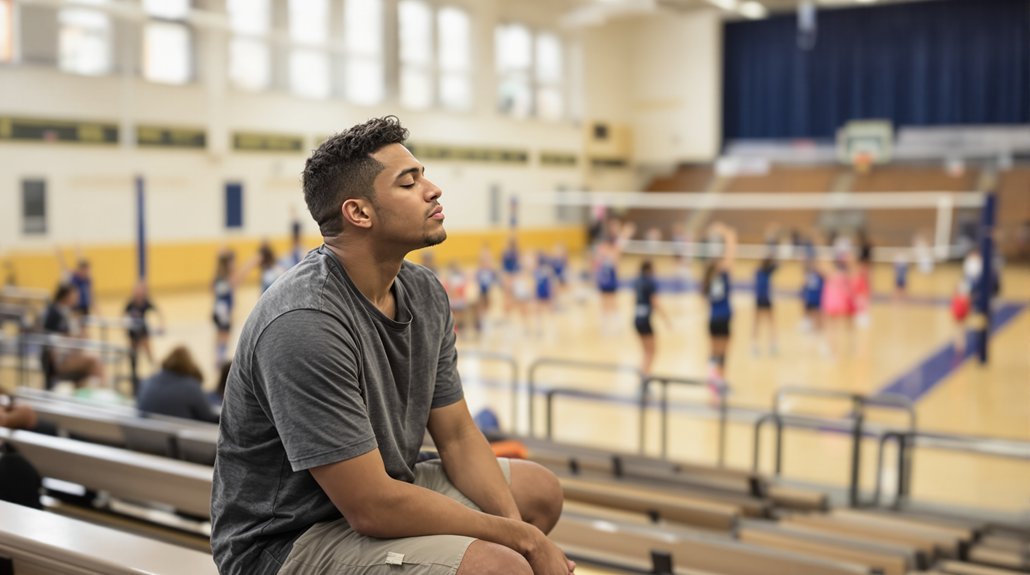
Your words matter, but your body language speaks even louder. Children detect your emotions through facial expressions and body posture with remarkable accuracy.
When you display visible stress—face-hiding, frowning, or head-shaking—your athlete’s anxiety increases and performance suffers. Research shows children of anxious parents are seven times more likely to develop anxiety disorders, primarily through modeled emotional responses.
Control your sideline presence with these strategies:
- Practice deep breathing exercises during tense moments to reduce immediate emotional reactivity
- Consider seat distancing by choosing obscured seating or taking separate transportation when emotions run high
- Wait twenty-four hours before discussing game concerns with coaches
- Focus on controllable positive behaviors rather than engaging with negative sideline dynamics
- Write down five positive actions your athlete performed to stay task-focused during play
Your emotional self-control models healthy responses for your child and inspires similar behavior among other spectators.
Help Your Child Be a Supportive Teammate
Great players don’t just excel individually—they lift their teammates through consistent support and encouragement. Help your child develop this skill by teaching them to praise specific efforts rather than just results. Instead of saying “good job,” encourage statements like “great communication on that play.” Teach them to call teammates’ names and say “mine” to prevent confusion during games.
Off court bonding strengthens on-court trust. Encourage your child to participate in team activities outside practice, building friendships that translate to better teamwork. Establish team rituals that create shared experiences and identity.
When mistakes happen, guide your child to respond positively. Phrases like “we’ll get the next one” maintain team morale better than silence or frustration. A player’s confidence positively influences teammates, creating an uplifting atmosphere that helps the entire team perform better. This supportive approach creates stronger teams.

Respect Coaches’ Decisions and Officials’ Calls
When coaches make decisions during games—whether substituting players, calling timeouts, or adjusting strategy—they’re drawing on experience and knowledge that extends beyond what any single player can see from the court.
Research shows that setters receive 75% of coach communication during timeouts, demonstrating how strategic these moments are.
Your modeling of coach authority and officials respect directly influences your child’s development.
Support decision-making by:
- Trusting tactical adjustments – Coaches combine opponent analysis with technical feedback for peak performance
- Accepting substitution decisions – 74% of coaches manage multiple teams, bringing diverse experience to choices
- Maintaining composure with referee calls – Emotional reactions undermine respect for game structure
- Discussing decisions after games – Post-match conversations build understanding without undermining authority
Your child’s respect for authority strengthens their overall athletic development.
Studies reveal that coaches predominantly use informing tasks focused on technical instruction, which means their practice decisions reflect a systematic approach to skill development rather than arbitrary choices.
Celebrate Progress Beyond the Win-Loss Record

Just as respecting authority figures teaches your child professionalism, recognizing their individual growth—separate from team victories—builds lasting confidence and motivation.
Modern volleyball programs track skill milestones across hitting, passing, setting, defense, and serving using 0-10 scales. These measurements show tangible improvement even during losing streaks.
Process metrics like serve reception efficiency, functional movement scores, and rotation-specific performance reveal development that win-loss records can’t capture.
When your daughter improves her handgrip strength by 15% or maintains consistent setting form under pressure, that’s measurable progress. Celebrate when she executes three consecutive clean passes or serves five balls in-zone during practice.
These specific achievements build the foundation for long-term success and demonstrate that growth happens daily, regardless of Saturday’s scoreboard. Jump-height metrics can evaluate her explosiveness in attacking and blocking, providing another objective way to track her physical development over time.

Volleyball Training Equipment Aid: The volleyball equipment is a must-have for players of all levels who are looking to improve their serving, setting, and spiking skills. It provides a comprehensive training experience that targets all aspects of the game.

All-in-One Volleyball Gift Set – Includes a solo serve trainer, setting trainer, quality backpack, volleyball bracelet, and 50 fun stickers. A perfect gift for volleyball-loving teens!
Description|Table of Contents|Author|Excerpts|Sample Content|Quotes
Keep Volleyball in Perspective Within Your Child’s Life
Too often, parents and young athletes allow volleyball to consume their entire identity, creating a precarious foundation for mental health and long-term development.
When volleyball becomes everything, young athletes build their sense of self on unstable ground that crumbles under pressure.
Research shows that 54.4% of female volleyball athletes develop high athletic identity, which increases mental health vulnerability when they can’t participate.
The solution lies in fostering identity balance through alternative interests.
Help your daughter build a well-rounded identity:
- Encourage academic investment – Youth who maintained educational focus alongside sports showed lower adult depressive symptoms
- Support multiple hobbies – Athletes with diverse interests report 1.5 times higher meaning and purpose levels
- Promote non-sport friendships – Social connections outside volleyball create resilience during injury or off-seasons
- Model balanced priorities – Your perspective directly influences how she views volleyball’s role in her life
Research indicates that continuous participation in organized sports through age 18 correlates with fewer adult symptoms of anxiety and depression compared to those who drop out. However, this doesn’t mean volleyball should dominate every aspect of life—the key is maintaining positive, enjoyable experiences within a broader developmental context.
Frequently Asked Questions
Recent Posts

How Do I Handle Conflicts With Other Parents About Playing Time?
Avoid direct confrontations with other parents about playing time. Instead, encourage a calm conversation between your child and their coach first—this respects the team’s hierarchy.
If you must get involved, set expectations by requesting a private meeting with the coach 24 hours after the game. Focus on your child’s development, not comparisons with other players. Document concerns objectively and keep discussions professional, avoiding sideline debates entirely.
What Should I Do if My Child Wants to Quit Mid-Season?
Start with an emotional check-in to understand what’s driving their desire to quit—is it burnout, conflict, or loss of enjoyment? Listen without judgment.
Then help them take a long-term perspective by discussing whether this is temporary frustration or a deeper issue.
Consider compromises like reduced practice schedules or modified roles.
If they’re truly burned out, quitting might be appropriate, but encourage finishing the season to honor their commitment and develop resilience.
How Can I Address Concerns About Team Favoritism With the Coach?
Schedule a private meeting when the coach isn’t rushed, and approach with open dialogue rather than accusations. Request examples of how playing time decisions are made, asking if they use objective metrics or specific criteria.
Document patterns you’ve noticed with dates and situations. Since over 45 percent of youth athletes face negative coaching interactions, staying polite increases your chances of productive resolution.
Focus on your child’s development and understanding the team’s philosophy.
Should I Hire a Private Coach for Additional Skill Development?
Private lessons can accelerate your child’s development if they’re motivated and need targeted skill work.
Rates typically range from $40-$75 per hour for experienced coaches, though group sessions reduce costs to $30-$60 per athlete.
Before investing, make sure the coach has proper credentials and uses appropriate techniques.
Establish clear goal tracking to measure progress.
Consider online coaching platforms first—they’re 95% cheaper and offer flexible scheduling while still providing personalized feedback.
How Do I Balance Multiple Children’s Volleyball Schedules and Commitments?
Create a family calendar that maps out all volleyball commitments three months ahead.
Identify which child’s sport takes priority each season based on their passion level and current competition phase.
Schedule priority meetings monthly to review conflicts and adjust transportation plans.
Build 30-minute buffers between overlapping practices.
Communicate scheduling constraints to coaches at least two weeks in advance, and document attendance patterns to make informed decisions about future commitments.
Bottom Line
Your steady presence—win or lose—shapes how your child views competition and growth. By celebrating effort over outcomes, keeping emotions in check, and pointing out concrete improvements like faster footwork or clearer calls, you build resilience that extends far beyond the court. Remember, you’re raising a person, not just a player. Balance, perspective, and unconditional support matter more than any trophy.