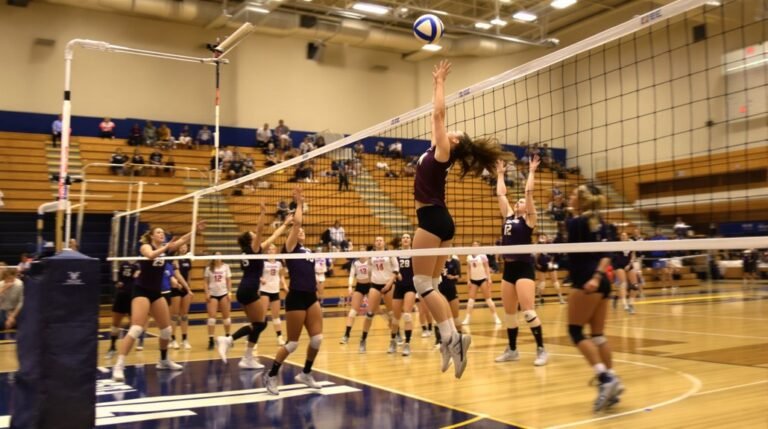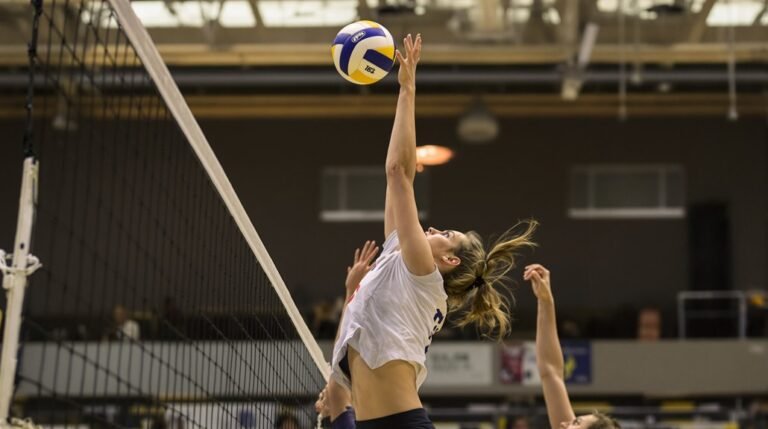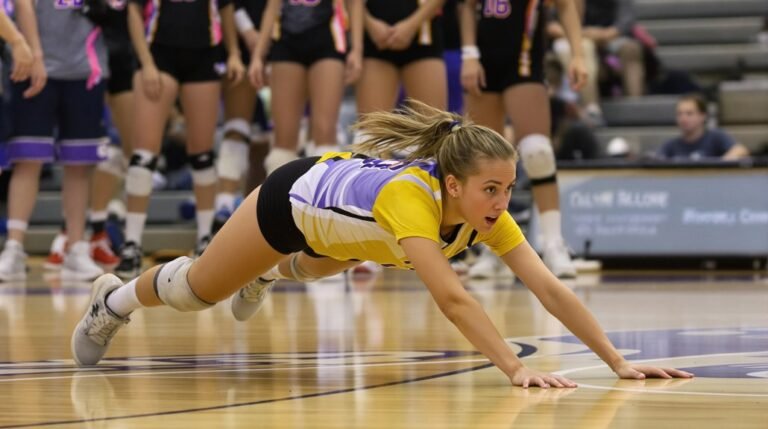


If you’ve ever watched a volleyball match and wondered why players shuffle around the court after each side-out, you’re not alone. Rotations can seem confusing at first, but they’re actually built on a simple system of six numbered positions that dictate serving order and court alignment. Once you understand how these positions work together, you’ll spot rotation violations before the referee does—and that knowledge starts with the basics.
Key Takeaways
- Six court positions are numbered clockwise, with players rotating one spot clockwise each time their team wins the serve.
- Players must maintain correct rotational positions until the server contacts the ball to avoid overlap faults.
- Front-row players handle attacking and blocking while back-row players focus on serve receive and defense.
- After serve contact, players can freely move from rotational spots into preferred tactical positions for offense.
- The starting lineup locks the serving sequence for the entire set, ensuring consistent rotation order throughout play.
What Are Volleyball Rotations and Why Do They Matter?
Rotations form the heartbeat of volleyball’s structure, keeping the game fair and forcing teams to develop well-rounded skills. Each of the six players on court occupies a numbered spot, creating a fixed serving order that stays consistent throughout the set. When your team wins the serve from the opponent—called a side-out—everyone shifts one position clockwise.
Understanding youth volleyball rotation basics helps you grasp why this system exists. It prevents teams from hiding weaker players and guarantees everyone serves, passes, and plays both front and back row. Your serve receive rotations depend on these positions, so mastering them early builds a strong foundation. The clockwise movement keeps things predictable, letting you focus on skills rather than confusion about where to stand.

The Six Court Positions and Their Responsibilities
Picture the volleyball court as a clock face, with six numbered zones that dictate where you stand and what you’re responsible for during each rally.
Think of the court as a clock — six zones, each with a job to do every single rally.
The positions run clockwise starting from the server’s spot. Position 1 is right back, where you serve from. Position 2 sits at right front, followed by position 3 at middle front and position 4 at left front.
Wrapping around, position 5 is left back, and position 6 is middle back.
Front-row players in positions 2, 3, and 4 handle attacking and blocking. Back-row players in positions 1, 5, and 6 focus on serve receive and defense. They can’t attack above the net in front of the 10-foot line.
Each front player must stay closer to the net than their corresponding back-row teammate when the serve happens.

PASS LIKE A PRO: Use the Pass Rite volleyball training gear to teach proper passing technique by limiting excessive upward arm movement. Small, lightweight velcro wrist and ankle cuffs minimize ball contact and interference
Complete Volleyball Training Equipment: This all-in-one package includes a Pouch, perfected Waistband, improved Elastic Cord, upgraded Hand Straps, larger Drawstring Backpack and Gift Box, making it a great Volleyball gift.

Volleyball Rebounder Kit: Elevate your volleyball training with our comprehensive equipment set! Our package includes a volleyball trainer waist belt for stability, an improved elastic cord, upgraded hand straps, two setting straps, two finger trainers, and a convenient drawstring backpack
Understanding the Serving Order and Numbered Spots
Before each serve, every player on the court occupies one of six numbered spots that determine both their position and their place in the serving order. Spot 1 sits at right back—that’s always where the server stands. From there, you’ll find spot 2 at right front, spot 3 at middle front, spot 4 at left front, spot 5 at left back, and spot 6 at middle back.
When your team wins the serve on a side-out, everyone rotates one position clockwise. The player in spot 6 shifts to spot 1 and becomes the new server.
Your starting lineup locks in the serving order for the entire set, and you must maintain that sequence at each serve to avoid an overlap fault. After the serve, you’re free to move into your preferred positions.


Ample Supply: you will receive 12 rectangular court marker lines, enough to be applied to represent the edge of the service court, baseline, and sideline
Ample Supply: you will receive 24 rectangular court marker lines, enough to be applied to represent the edge of the service court, baseline, and sideline
![DDVLG Beach Volleyball Lines for Sand or Grass, 2inch Sand Volleyball Boundary Lines for Beach Court 26.3'x52.6' [Doubles 2V2], Highly Visible, All-Weather, with Metal Anchors & Sand Bags - Blue](https://m.media-amazon.com/images/I/51VlbxdKisL._SL500_.jpg)
【Durable All-Weather Performance】Experience superior beach volleyball with our sand volleyball lines doubles made from rip-resistant nylon, which is UV and weather-resistant, ensuring longevity and vibrant colors through all conditions
When and How Players Rotate During a Match
Once your team wins a rally while the other team is serving, everyone shifts one spot clockwise—that single rotation happens immediately before your team’s next serve.
Win the rally, earn the serve, rotate clockwise—it’s volleyball’s simple rhythm that keeps every player moving through each court position.
The player in position 1 (back-right) moves to position 6 (back-middle), and so on around the court.
Here’s the key rule: you must hold your correct rotational position until the server contacts the ball.
Front-row players stay slightly ahead of their back-row counterparts, and left-right relationships must be maintained.
Position 4 stays left of position 3, for example.
Once that serve is struck, you’re free to move anywhere.
Your setter can sprint from the back row to the net.
Your hitters can shift to their preferred attacking zones.
The rotation spot is just your starting checkpoint—not where you’ll play the entire rally.

All-in-One Volleyball Gift Set – Includes a solo serve trainer, setting trainer, quality backpack, volleyball bracelet, and 50 fun stickers. A perfect gift for volleyball-loving teens!

Great Volleyball Gift:Focopot Volleyball Training Kit includes a ball pouch with retractable cord, an adjustable waistband, two hand straps, and a portable backpack, making it the perfect volleyball gift.
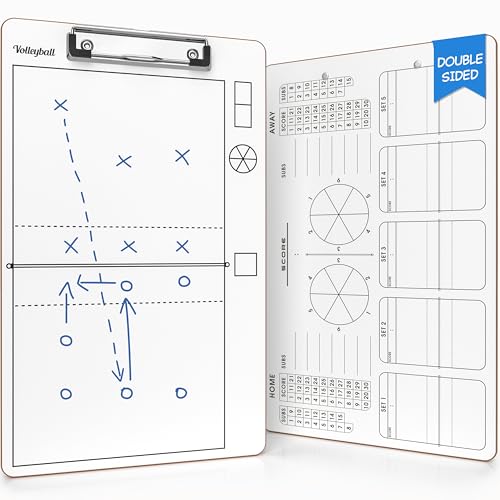
DOUBLE-SIDED DESIGN - This dry erase volleyball coaching board is double sides with a full court on the front and a Volleyball Rotation Wheel with a box score line up on the backside to help coaches get a clear picture of the full volleyball play board.
Overlap Rules and How to Avoid Violations
Although you’re free to roam the court after the serve, the moment that ball leaves the server’s hand is when positioning matters most.
Each player must maintain correct relationships with teammates—front-row players stay ahead of their back-row counterparts, and left/right players remain closer to their respective sidelines than the middle player.
An overlap happens when you’re caught out of position at serve contact. The penalty? Your opponent scores a point.
Here’s how you avoid this headache: mark six rotation spots on your court during practice. Rehearse the clockwise rotation until it’s automatic.
Before each serve, call out your next position to teammates. The libero doesn’t play front row but still follows left/right positioning rules.
Smart teams use legal pre-serve spots that allow quick post-serve shifts into preferred formations.

Front Row Versus Back Row Player Responsibilities
Knowing where to stand at the serve is only half the equation—the real difference between front-row and back-row players comes down to what you’re allowed to do with the ball.
Front-row players at left front, middle front, and right front can block at the net and attack from anywhere in front of the 3-meter line. Back-row players don’t share these privileges. If you’re in the back row and want to attack, you must jump from behind that 3-meter line—no exceptions.
Once the serve crosses the net, you’re free to move into your tactical position. A middle blocker rotating through left front can shift to the center. However, the front-row and back-row restrictions follow you based on your rotational position, not your physical location.
How the Libero Fits Into the Rotation System
Because the libero operates under a completely different set of rules, this specialized defensive player doesn’t rotate through the front row like everyone else.
Instead, the libero stays exclusively in the back row, replacing designated back-row players through special libero substitutions that don’t count against your team’s regular substitution limit.
When the libero enters, they take the exact rotational position of the player they’re replacing.
The libero seamlessly slots into the exact rotational spot of the player they replace—no shuffling required.
That player can only return through a regular substitution or when the libero exits.
You’ll need to record your libero on the lineup sheet before each set to avoid rotation faults.
Here’s what the libero can’t do: attack when the ball is completely above the net, block, or attempt to block.
In most competitions, the libero also can’t serve.
Common Rotation Mistakes and How to Fix Them
Even experienced players make rotation errors that hand easy points to opponents, so understanding these common mistakes can save your team from frustrating penalties.
The most frequent violations happen at the moment of serve. Here are three key areas to watch:
- Front/back overlap – Your front-row players must have part of a foot closer to the net than their corresponding back-row teammate.
- Left/right confusion – Each left-side player needs part of a foot closer to the left sideline than the middle player, and right-side players must be closer to the right sideline.
- Forgetting clockwise rotation – After a side-out, practice the sequence RB → RF → MF → LF → LB → MB until it’s automatic.
Don’t adjust your position until after the serve contacts the ball. Move immediately after, not before.
Transitioning From Serve-Receive to Offensive Formations
Once the server’s hand strikes the ball, your team can finally break out of those rigid rotational positions and shift into an actual offensive formation. Your three front-row players stay near the net while back-row teammates prepare to support or attack.
Here’s where it gets interesting. Your setter, often starting in left-back during serve-receive, immediately sprints toward the front-right area to run the offense. Meanwhile, your back-row attackers can move forward but must remember the 10-foot attack line—any hits they take must launch from behind it.
Practice this movement using a simple “serve, pass, set” sequence. Your passers direct the ball to the setter’s target zone while hitters time their approaches. The goal? Everyone arrives ready the instant the setter releases the ball.
Recent Posts

Drills and Practice Methods for Mastering Rotations
Knowing where to move after the serve is one thing—getting there automatically takes deliberate practice.
You’ll want to build muscle memory through repetition so rotations become second nature during matches.
Try these three proven drills to sharpen your team’s positioning:
- Clockwise rotation drill: Mark all six spots with cones, rotate every 30 seconds, and call your new position aloud for 5 minutes straight.
- Serve-freeze drill: After each side-out, the server sends the ball over, everyone freezes on first contact, and your coach checks alignment for 30 reps.
- Transition reps: Start in legal rotational spots, whistle the serve, then move to offensive positions—run 10 reps per rotation.
Daily 3-minute timed lineup quizzes also reduce mental errors when pressure hits.
Frequently Asked Questions
Can a Coach Change the Rotation Order Between Sets in a Match?
Yes, you can change your rotation order between sets.
Once a set begins, though, your lineup is locked—players must rotate in that exact sequence until the set ends.
Before the next set starts, you’re free to submit a completely new lineup with different rotation spots. This flexibility lets you adjust strategy based on matchups or how players are performing that day.
How Do International Volleyball Rotation Rules Differ From High School Rules?
International and high school volleyball follow the same basic rotation rules—you’ll keep the same numbered positions and serving order throughout each set.
The main differences aren’t in rotation mechanics but in other areas like substitution limits and libero usage.
FIVB international rules allow six substitutions per set, while high school rules (NFHS) permit 18.
Your rotation structure, however, stays consistent across both levels.
What Happens if a Team Submits an Incorrect Lineup Sheet?
If your team submits an incorrect lineup sheet, the referee will catch it during the pre-game check or when a rotation fault occurs. You’ll need to correct the lineup immediately.
The opposing team might receive a point and the serve if the error affects play. Each player has a numbered rotation spot and a serving order, so double-check your sheet before handing it in.
Are Rotation Rules Different for Beach Volleyball Versus Indoor Volleyball?
Yes, rotation rules differ markedly between the two formats. In indoor volleyball, you follow a six-person rotation with numbered positions and a fixed serving order.
Beach volleyball’s simpler—you’ve got just two players alternating serves, with no positional requirements. You can stand anywhere on your side of the court. Indoor requires staying in your rotation spot until the serve’s contacted; beach gives you complete freedom of movement.
How Do Substitutions Affect the Original Rotation Order During Play?
When you substitute a player, they must take the exact rotation spot of the person they’re replacing. Your original serving order stays locked in—it doesn’t shift.
For example, if your setter enters for the player in position 4, they’ll rotate through all six spots just like that original player would have. Each substitute effectively “inherits” their predecessor’s numbered position in the rotation sequence.
Bottom Line
Mastering volleyball rotations takes consistent practice, but you’ll see results quickly once the basics click. Start with slow walkthroughs, then gradually increase speed until movement becomes automatic. Focus on maintaining proper court alignment before each serve and communicate with teammates during shifts. Whether you’re running a 5-1 or 6-2 system, solid rotation fundamentals give your team a competitive edge. Put in the reps, and you’ll rotate with confidence.