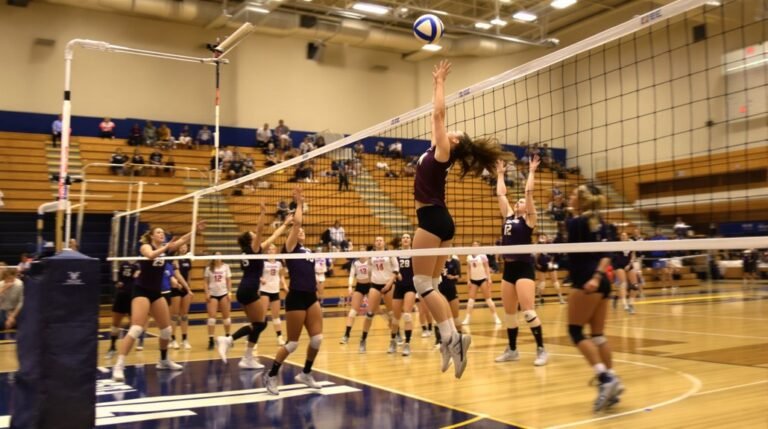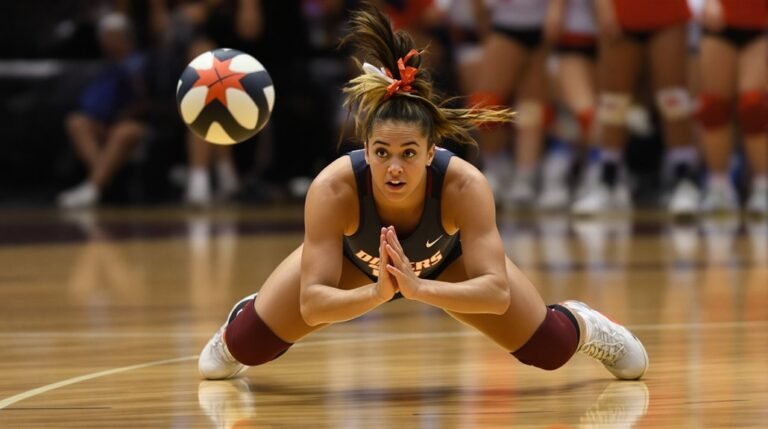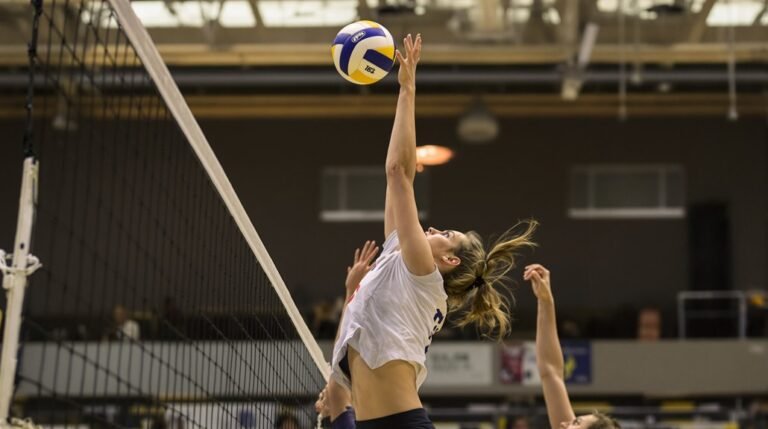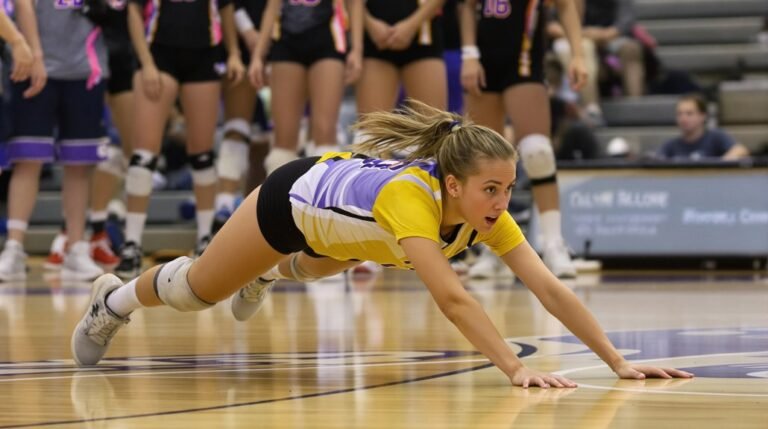


If you’ve ever watched a volleyball match and wondered why certain players seem glued to specific spots while others roam freely, you’re not alone. Each position on the court serves a distinct purpose, from the setter orchestrating every offensive play to the libero diving for impossible digs. Understanding these six roles won’t just help you follow the game—it’ll change how you see every point unfold.
Key Takeaways
- The setter runs the offense by delivering sets to attackers and calling plays using hand signals and quick decision-making.
- Outside hitters are versatile primary attackers who receive most sets and play all six rotations, handling offense and defense.
- Opposite hitters score from the right side, block opposing outside hitters, and can substitute as setters when needed.
- Middle blockers are tall players who anchor net defense, execute quick attacks, and read opposing setters to close blocking gaps.
- The libero wears a different jersey, substitutes freely, and specializes in back-row defense without attacking at the net.
Setter: The Playmaker Who Runs the Offense
Every rally flows through the setter’s fingertips. As the team’s playmaker and quarterback, you’ll handle the second touch on nearly every possession. Your job? Deliver precise sets to your hitters while reading the defense in real time.
You’ll need sharp court vision to track blockers, passers, and attackers simultaneously. Before the ball even arrives, you’re flashing hand signals to call plays—quick sets to the middle, high balls outside, or back-row attacks. Smart distribution keeps opponents guessing and creates mismatches your hitters can exploit.
Strong setting skills mean consistent hands and quick decision-making. You’re directing the entire offense, rarely leaving the court, and communicating constantly with teammates. Think of yourself as the point guard of volleyball—every successful attack starts with your touch.


PATENT PENDING volleyball setter trainer equipment.

PERFECT SET: A must-have training accessory for developing fundamental setting form; Set includes 2 set trainers for volleyball players of all skill levels

Precision Target Cloth for Perfect Accuracy: Master your sets with our exclusive precision training cloth, designed to improve your setter accuracy like never before. The long ball return channel ensures seamless practice, allowing you to focus on repetitions without constant ball retrieval.
Outside Hitter: The Go-To Attacker on the Left Side
While the setter orchestrates the offense, someone has to put the ball away—and that’s usually the outside hitter. Also called the left-side hitter, you’re the primary attacker receiving about 60% of all sets. You’ll need a strong vertical jump and quick footwork to execute back-row attacks behind the 10-foot line.
| Skill | Why It Matters |
|---|---|
| Serve-receive | You’ll pass in back-row rotations |
| Blocking | You defend the left side of the net |
| Pass-receive | Keeps plays alive when passes aren’t perfect |
| Versatility | You stay in for all six rotations |
Your job demands endurance. You’re attacking, passing, blocking, and playing defense every single rotation. That versatility makes outside hitters invaluable to any team.

Breathable mesh underlays

Breathable mesh underlays

Breathable mesh upper
Opposite Hitter: The Versatile Right-Side Scorer
Stationed on the right side of the net, the opposite hitter serves as your team’s second-leading scorer and a critical defensive anchor. Also called the right-side hitter, you’ll attack primarily from zone 2 while blocking the opponent’s outside hitter. Left-handed hitters often thrive here because they get better hitting angles, but right-handers succeed too with strong line shots.
Your role demands versatility across the team’s offense:
- Execute back-row attacks by jumping behind the 10-foot line
- Act as a secondary setter when your setter’s out of position
- Maintain blocking continuity without libero substitution
You’ll need solid court awareness and decent ball-handling skills. Whether attacking from right front or defending against the opponent’s best attacker, you balance scoring with smart defensive plays.

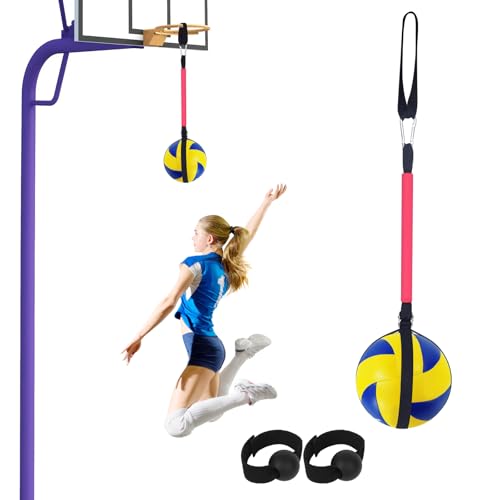
GREAT TRAINER: Hitters also improve timing, speed and power of hitting approach with this volleyball SPIKE training system.

Durable Micro-fiber composite

Great Volleyball Gift:Focopot Volleyball Training Kit includes a ball pouch with retractable cord, an adjustable waistband, two hand straps, and a portable backpack, making it the perfect volleyball gift.
Middle Blocker: The Defensive Wall at the Net
The opposite hitter guards the right side, but the middle blocker owns the center—and that’s where you’ll find your team’s tallest player forming a defensive wall. Also called the middle hitter, this position serves as your team’s first line of defense against opponent attacks.
Your job is to read the setter quickly and move laterally to close blocking gaps. You’ll execute quick sets with precise timing, often acting as a decoy to pull defenders away from teammates.
| Skill | Purpose | Key Metric |
|---|---|---|
| Blocking | Stop opponent attacks | Blocks per set |
| Quick attacks | Score fast points | Hit percentage |
| Reading hitters | Anticipate plays | Reaction time |
Most teams substitute their middle blocker for a libero when rotating out of the front row.
Back-Row Specialists: Libero and Defensive Specialist Roles
Because back-row defense requires specialized skills, most teams rely on two key positions: the libero and the defensive specialist.
You’ll spot the libero immediately—they wear a contrasting jersey and can substitute freely without counting toward the team’s limit.
They stay in the back row, focusing on serve receive and digging hard-driven attacks.
A defensive specialist handles similar duties but uses standard substitutions and can rotate to the front row when needed.
Both positions help pass to the setter effectively and strengthen floor defense.
Here are three key differences to remember:
- The libero has setting restrictions near the 10-foot line; the defensive specialist does not.
- Only the libero gets unlimited substitutions.
- Defensive specialists can serve without rotation limitations in most rule sets.

Frequently Asked Questions
What Are the 7 Positions in Volleyball?
You’ll find seven positions in volleyball: setter, outside hitter, opposite hitter, middle blocker, libero, and defensive specialist.
The setter responsibilities include running the offense and directing momentum play.
Outside and opposite hitters handle serve receive while attacking from different sides.
Middle blockers focus on blocking technique and quick hits.
Back row defense falls to the libero and defensive specialist, who substitute strategically based on rotation strategy.
What Is the Easiest Volleyball Position to Learn?
The easiest position to learn is libero or defensive specialist. You’ll focus on passing technique, defensive stance, and reaction time without worrying about hitting approach or front-row attacks.
Start with footwork drills and hand positioning for serve-receive. You’ll develop court awareness, learn basic rotations, and practice communication cues with teammates.
Serving practice rounds out your skills. This foundation builds confidence before you tackle more complex positions.
What Are the 3 C’s in Volleyball?
The 3 C’s in volleyball are communication, court awareness, and consistency.
You’ll use communication cues and coordinated calls to prevent collisions during plays.
Court chemistry develops when you understand clockwise rotations and clever coverage zones.
Consistent conditioning builds competitive consistency in your passes and serves.
Listen for coaching corrections to sharpen your skills.
With clutch confidence and smart corner cuts, you’ll contribute to smoother offensive systems and fewer team errors.
Recent Posts

Where Do You Put the Weakest Player in Volleyball?
You’d typically place your weakest player in a back row focus position like right-back (position 1), where a defensive specialist or libero can cover their serve receive placement.
If they’re a weakest server, use late substitution with a serving specialist.
Their rotational role should minimize pressure—keep them away from the low pressure setter’s primary options.
Provide communication support from teammates and use bench strategy during critical points while confidence building develops their skills.
Bottom Line
Now that you understand the five core volleyball positions, you’re ready to find your spot on the court. Whether you’re drawn to setting up teammates, spiking from the outside, or anchoring the defense as a libero, each role matters. Start by trying different positions during practice—you’ll quickly discover where your skills shine. The best players know every role, even if they specialize in one.