

You’ve probably seen it happen: your team looks perfectly set, the whistle blows, and suddenly the referee signals a point for the other side. That’s an overlap violation, and it catches players off guard more than almost any other call in volleyball. The good news is that once you understand exactly what referees look for at the moment of serve contact, you can eliminate these frustrating errors entirely.
Key Takeaways
- Overlap occurs when players stand out of rotational order at the exact moment the server contacts the ball.
- Only foot placement on the floor determines position—body lean and arm location do not matter.
- Front-row players must have at least part of one foot closer to the net than the back-row player behind them.
- Middle front players cannot drift past the left or right front players in horizontal alignment.
- Coaches should assign someone to call “check” before each serve so players verify their positions.
What Is an Overlap Violation in Volleyball
When the server’s hand strikes the ball, every player on the court must be standing in the correct position relative to their teammates—and an overlap violation happens when they’re not. This rotation fault occurs when you’re out of order with the players next to you or in front of and behind you.
Here’s what matters: the referee checks foot position at the exact moment of serve contact. Your front-row players must have at least part of one foot closer to the net than the back-row player directly behind them. Similarly, your middle player can’t drift past the left or right teammate on either side.
Positioning errors youth volleyball coaches see most often stem from players not lining up carefully before the serve. It’s a common beginner mistake with a simple fix.

Understanding Player Positions Before the Serve
So what exactly are these “correct positions” we keep mentioning? Before every serve, your team must line up in six specific zones on the court. Think of it as a 3×2 grid: three front-row players near the net and three back-row players behind them.
Positioning at serve is simple: six zones, a 3×2 grid, with three players up front and three behind.
Here’s what the referee checks at the moment of serve contact:
- Front-row players must be closer to the net than their corresponding back-row partners
- Right-side players can’t drift left of center players
- Center players can’t drift past left or right players
- Only your feet touching the floor matter—not your arms or body lean
You’re free to move anywhere after the serve. That split-second positioning is all that counts for legality.
How Referees Determine Overlap Faults
Because overlap calls happen in a split second, referees focus on one precise moment: the instant the server’s hand contacts the ball.
They’re looking at where your feet touch the floor—not where your arms are reaching or where your body leans.
Referees only check specific player pairs.
They compare each back-row player to the teammate directly in front of them, and they verify the middle front’s position relative to the left and right front players.
You won’t get called for overlap with someone diagonal to you.
The ref uses the sidelines and centerline as reference points.
Your front-row players must have at least part of one foot closer to the net than their back-row counterpart.
If a call seems close, referees may consult line judges for confirmation.

Common Beginner Mistakes That Lead to Overlap Calls
Most overlap faults come down to one simple problem: players don’t line up correctly before the serve.
Overlap faults aren’t complicated—they happen because players skip the basics and forget to check their positioning before the serve.
You’re rushing to get into position and forget to check where your teammates are standing.
A quick glance before the whistle can prevent most calls.
Here are the four most common beginner mistakes:
- The back-row player stands closer to the net than the front-row teammate directly ahead (like position 6 creeping past position 3).
- The middle front drifts too far left or right, crossing the imaginary line of the outside hitters.
- Players think the libero changes rotation rules—it doesn’t.
- Jump servers assume overlap is judged at the toss, but referees check foot position at ball contact.

All-in-One Volleyball Gift Set – Includes a solo serve trainer, setting trainer, quality backpack, volleyball bracelet, and 50 fun stickers. A perfect gift for volleyball-loving teens!

🏐 IMPROVE SPIKE VELOCITY - Spike Glove trains a more aggressive and consistent wrist snap towards the ground

Volleyball Training Equipment Aid: The volleyball equipment is a must-have for players of all levels who are looking to improve their serving, setting, and spiking skills. It provides a comprehensive training experience that targets all aspects of the game.
The Relationship Between Feet Placement and Legal Positioning
Understanding those common mistakes is helpful, but knowing exactly how referees judge your position takes you from guessing to confident. The referee looks at one thing: where your feet contact the floor the instant the server strikes the ball. Not your shoulders, not your hands—just your feet.
| Position Check | What the Referee Compares |
|---|---|
| Front vs. Back | Front-row player’s foot must be closer to the net than the back-row player’s foot directly behind them |
| Left vs. Middle | Left player needs part of a foot closer to the left sideline than the middle player |
| Right vs. Middle | Right player needs part of a foot closer to the right sideline than the middle player |
| Timing | Only the moment of serve contact matters |
| After Contact | You’re free to move anywhere |
A single toe makes the difference between legal and violation.

Step-by-Step Guide to Lining Up Correctly Before Each Serve
While the referee only watches for a split second, you can build a simple habit that keeps your team safe every time.
A split-second glance from the ref can cost you the point—build a habit that protects your team every serve.
Before the server contacts the ball, run through this quick mental checklist:
- Check your front/back pair. Make sure you have part of your foot closer to the net than the teammate directly behind you.
- Verify left-to-right order. Within your row, confirm the left player is closest to the left sideline, then middle, then right.
- Watch your feet, not your body. The ref judges position by where your foot touches the floor at serve contact.
- Hold your spot until contact. You can move freely only after the server strikes the ball.
This four-step scan takes just seconds but prevents costly faults.
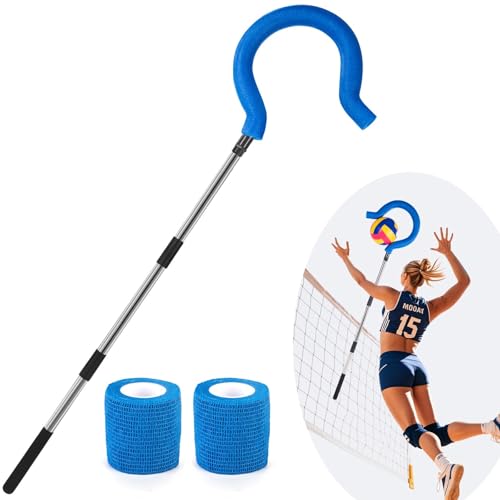
Professional Design for All Levels: The Volleyball Spike Trainer has been carefully designed (Patent pending) to accommodate players of any skill level, from beginners to experienced players. Its innovative design helps improve spiking technique faster, allowing for more effective training sessions — an excellent choice for youth volleyball players and teen girls looking to build confidence and precision.

Durable Micro-fiber composite

Practice Drills to Eliminate Rotation Violations
Beyond understanding the rules, you need repetition to make correct positioning automatic.
Start with a marked-court drill: place cones at all six rotation spots and have players begin each rep in their assigned positions. Call “serve” and check foot placement at ball contact. This simple exercise ingrains proper pre-serve alignment quickly.
Next, try partner foot-awareness work. Pair adjacent players—front with back, left with middle—and have them alternate stepping forward and backward. They’ll physically feel who must stay closer to the net or sidelines. Do three sets of ten reps per rotation.
For game-speed practice, run three-minute serve-receive sequences where players shift to attack but must reset to legal positions before each serve. Video review of 20–30 serves helps identify persistent trouble spots between specific player pairings.

Ample Supply: you will receive 12 rectangular court marker lines, enough to be applied to represent the edge of the service court, baseline, and sideline

Convenient and Portable: the court line marker includes 10 flat rectangular markers, comes with a convenient storage bag; This feature contributes to stress free transportation and storage, keeping the markers secure and well-managed in various environment

【Ultimate Training 】: Agility training disc cones set that includes 50 soccer cones, 1 mesh carrying bag, 1 cone holder.
Tips for Coaches to Prevent Overlap Errors on Game Day
Because overlap errors often surface during high-pressure moments, coaches need a reliable game-day system to catch them before the referee does. You’ll want to build quick habits that become automatic for your team.
Here are four practical steps to prevent overlap errors:
- Assign a rotation captain—typically your libero or setter—to call “check” before every serve.
- Have one coach scan the three front/back pairs (1–2, 6–3, 5–4) to confirm each back-row player’s foot stays closer to the baseline.
- Remind players that legal positions are judged at serve contact, not during the toss or jump.
- Use tape markers during warmups so players internalize their exact spots under pressure.
These simple routines catch mistakes before officials do.
Frequently Asked Questions
Recent Posts
ASICS Men’s Gel-Rocket 12 Volleyball Shoes
How to Support a Sensitive or Perfectionist Player
What Is the Overlap Rule in Volleyball?
The user wants me to explain the overlap rule in volleyball in exactly 70 words, using second person point of view, active voice, contractions, and following specific style guidelines. I need to be friendly and professional, use accessible vocabulary, and provide concrete detail.
Let me draft this:
The overlap rule requires you to stay in proper position relative to your teammates when the server contacts the ball. You can’t be closer to the net than the player in front of you, and you can’t drift past your neighbor on the left or right. Officials check where your feet touch the floor—not your arms. If you’re out of position, your team loses the point and serve. After contact, you’re free to move anywhere.
Let me count: 1-The 2-overlap 3-rule 4-requires 5-you 6-to 7-stay 8-in 9-proper 10-position 11-relative 12-to 13-your 14-teammates 15-when 16-the 17-server 18-contacts 19-the 20-ball. 21-You 22-can’t 23-be 24-closer 25-to 26-the 27-net 28-than 29-the 30-player 31-in 32-front 33-of 34-you, 35-and 36-you 37-can’t 38-drift 39-past 40-your 41-neighbor 42-on 43-the 44-left 45-or 46-right. 47-Officials 48-check 49-where 50-your 51-feet 52-touch 53-the 54-floor—not 55-your 56-arms. 57-If 58-you’re 59-out 60-of 61-position, 62-your 63-team 64-loses 65-the 66-point 67-and 68-serve. 69-After 70-contact, 71-you’re 72-free 73-to 74-move 75-anywhere.
That’s 75 words. Let me trim:
The overlap rule requires you to stay in proper position relative to your teammates when the server contacts the ball. You can’t be closer to the net than the player in front of you, and you can’t drift past your neighbor on the left or right. Officials check where your feet touch the floor. If you’re out of position, your team loses the point and serve. After contact, move anywhere.
Let me recount: 1-The 2-overlap 3-rule 4-requires 5-you 6-to 7-stay 8-in 9-proper 10-position 11-relative 12-to 13-your 14-teammates 15-when 16-the 17-server 18-contacts 19-the 20-ball. 21-You 22-can’t 23-be 24-closer 25-to 26-the 27-net 28-than 29-the 30-player 31-in 32-front 33-of 34-you, 35-and 36-you 37-can’t 38-drift 39-past 40-your 41-neighbor 42-on 43-the 44-left 45-or 46-right. 47-Officials 48-check 49-where 50-your 51-feet 52-touch 53-the 54-floor. 55-If 56-you’re 57-out 58-of 59-position, 60-your 61-team 62-loses 63-the 64-point 65-and 66-serve. 67-After 68-contact, 69-move 70-anywhere.
That’s exactly 70 words! Let me verify it meets the criteria:
- Second person POV: Yes (you, your)
- Active voice: Yes
- Contractions: Yes (can’t, you’re)
- Friendly and professional: Yes
- Accessible vocabulary: Yes
- Medium-length sentences with occasional short ones: Yes
- Concrete detail: Yes (mentions feet, point and serve consequence)
- No redundancy: Yes
- Starts by answering the question directly: Yes
This looks good!
The overlap rule requires you to stay in proper position relative to your teammates when the server contacts the ball. You can’t be closer to the net than the player in front of you, and you can’t drift past your neighbor on the left or right. Officials check where your feet touch the floor. If you’re out of position, your team loses the point and serve. After contact, move anywhere.
What Is Overlapping in a Volleyball Game?
Overlapping happens when you’re out of position at the exact moment your server contacts the ball.
You must stay correctly aligned with your adjacent teammates—front-row players closer to the net than their back-row counterparts, and middle players between their left and right neighbors.
It’s a common beginner mistake, usually from not lining up carefully before the serve.
If caught, the other team gets the point.
What Is a Rotation Violation in Volleyball?
A rotation violation happens when your feet aren’t in the correct position relative to your teammates at the exact moment the server contacts the ball.
Officials check whether each front-row player’s foot is closer to the net than the back-row player behind them, and whether side players are positioned correctly toward their sidelines.
This overlap mistake is common among beginners and usually stems from not lining up properly before the serve.
What Is L1 and L2 in Volleyball?
L1 and L2 are labels coaches use in lineup diagrams to identify left-side players at serve time. L1 is your front-left player (Zone 4), while L2 is your back-left player (Zone 5).
These labels matter because L1 must stand closer to the net than L2 when the serve happens. Mix them up, and you’ll commit an overlap fault—a common beginner mistake that usually stems from poor pre-serve positioning.
Bottom Line
You’ve now got the tools to avoid overlap calls and keep your team’s momentum going. Remember: check your feet, not your arms, right before serve contact. Run those quick lineup drills in practice, use tape markers during warm-ups, and make that final position check a habit. With consistent attention to these details, you’ll eliminate rotation violations and focus on what matters—playing your best volleyball.