


If you’ve ever watched a volleyball match and wondered why players keep switching spots or why that one person wears a different colored jersey, you’re not alone. Understanding volleyball’s rules transforms confusing chaos into a game you can follow—and enjoy. From the 18×9 meter court dimensions to the three-contact limit, every rule serves a purpose. Once you know the basics, you’ll spot plays and violations most spectators miss entirely.
Court Dimensions and Equipment Basics
Before you can master the game, you’ll need to understand the playing surface and gear that make volleyball possible.
A standard indoor volleyball court measures 18 meters long by 9 meters wide, with a centerline dividing it into two equal halves beneath the net. The net height sits at 2.43 meters for men and 2.24 meters for women.
You’ll notice the attack line marked 3 meters from the centerline on each side—this separates front-court players from back-court positions.
The boundary lines, including both sidelines and each end line, are 5 centimeters wide. Here’s a key detail: if the ball touches any line, it’s in bounds.
The official volleyball ball weighs 260–280 grams with a 65–67 centimeter circumference.
Understanding these court dimensions gives you a solid foundation.

【Upgraded All Weather Resistance】Our beach volleyball lines for sand has a big improvement: Made of superior rip-resistance nylon, which is strictly UV, anti-aging and weather treated; Withstand all extreme weather and place, securing longer lifetime and lasting colors
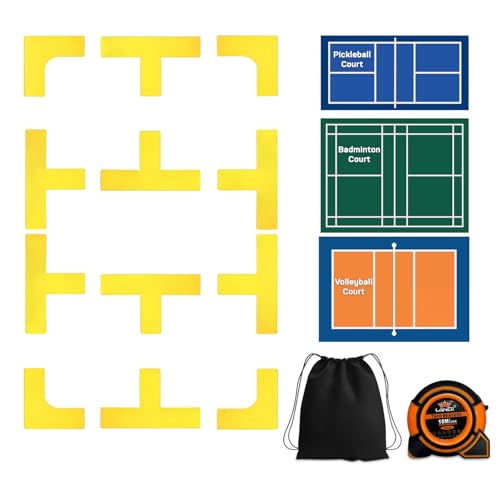
Play Anywhere, Practice Like a Pro: Turn any driveway, park, or gym into a regulation-ready court in minutes. With accurate court lines, a 33ft tape measure, and easy-to-follow reference cards, the Acpape Pickleball Court Marking Kit helps you set up correctly the first time—so you spend less time measuring and more time improving your game.
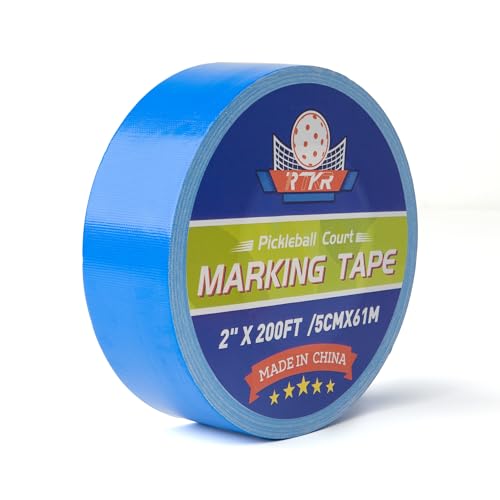
Zero-Residue Removal & Clean Surfaces: Peel away effortlessly leaving absolutely no sticky residue behind. Perfect for protecting gym floors, driveways, and outdoor courts, ensuring a pristine surface every time. (2 inches wide)
Player Positions and Rotation Rules
Now that you know the court layout, let’s look at where players actually stand and how they move during a match. Volleyball uses six rotational positions numbered 1 through 6. Three players occupy the front row (positions 2, 3, 4), while three stay in the back row (positions 1, 6, 5).
Here’s the key rule: you must be in your correct position when the serve is contacted. After that, you’re free to move. This is why your setter can receive the ball and quickly shift to run the offense.
When your team wins a rally and earns the serve, everyone rotates one spot clockwise. The libero wears a different jersey and can replace any back-row player without counting as a substitution. They can’t attack above the net from in front of the attack line.

How Scoring Works in Volleyball
Every rally counts in volleyball, and that’s not just a figure of speech—it’s literally how the scoring system works. Under rally scoring, someone earns a point on every single play. You score through an ace (a serve that hits the floor untouched), a kill (an attack that ends the rally), or an opponent’s fault like touching the net.
When you win a rally, your team keeps the serve. Lose it, and the other team gets the ball after a rotation. Most sets go to 25 points, but here’s the catch: you need a two-point advantage to win. The deciding set only goes to 15, though the same margin applies. Games can stretch beyond these targets until one team pulls ahead by two.
Serving Rules and Techniques
The serve launches every rally into motion, and where you stand matters just as much as how you strike the ball. You must contact the ball from behind the service line—stepping on or over it before contact results in a foot fault and costs your team the point.
A let serve that clips the net remains in play, so don’t stop if it goes over. If your serve lands untouched in the opponent’s court, you’ve earned an ace.
You’ll encounter three main serve types: the float serve wobbles unpredictably with minimal spin, the jump serve delivers power with topspin, and the jump float combines both approaches. Your team must maintain proper rotation order during service, or officials will call a fault. The serve receive team prepares accordingly.


Great Volleyball Gift:Focopot Volleyball Training Kit includes a ball pouch with retractable cord, an adjustable waistband, two hand straps, and a portable backpack, making it the perfect volleyball gift.

Volleyball Training Equipment Aid: The volleyball equipment is a must-have for players of all levels who are looking to improve their serving, setting, and spiking skills. It provides a comprehensive training experience that targets all aspects of the game.

Volleyball Rebounder Kit: Elevate your volleyball training with our comprehensive equipment set! Our package includes a volleyball trainer waist belt for stability, an improved elastic cord, upgraded hand straps, two setting straps, two finger trainers, and a convenient drawstring backpack
Ball Handling and Contact Rules
Once your team receives the serve, you’ve got three contacts to work the ball back over the net—and how you handle each touch determines whether play continues or the whistle blows.
Here’s the key rule: you can’t hit the ball twice in a row. That’s a double contact fault. The exception? A block doesn’t count as one of your three hits, so the blocker can play it again immediately.
Every ball contact must be clean. You can’t catch, hold, or let the ball rest in your hands—referees call this a lift or carry. Any body parts work legally, from your hands to your foot.
When two teammates touch the ball at the same moment, simultaneous contacts count as one team hit. Also, a net touch during play is fine if the ball crosses legally.

All-in-One Volleyball Gift Set – Includes a solo serve trainer, setting trainer, quality backpack, volleyball bracelet, and 50 fun stickers. A perfect gift for volleyball-loving teens!

PERFECT SET: A must-have training accessory for developing fundamental setting form; Set includes 2 set trainers for volleyball players of all skill levels
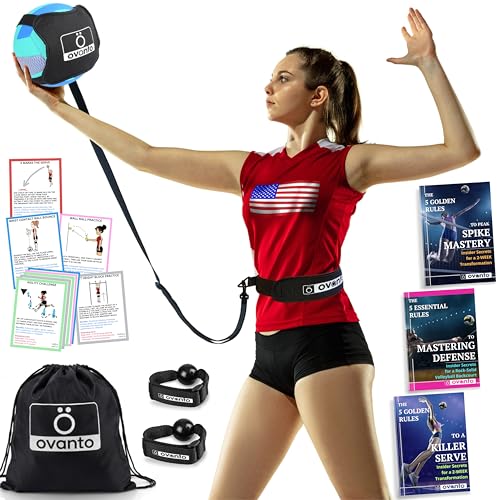
Complete Volleyball Training Equipment: This all-in-one package includes a Pouch, perfected Waistband, improved Elastic Cord, upgraded Hand Straps, larger Drawstring Backpack and Gift Box, making it a great Volleyball gift.
Net Play and Blocking Regulations
At the net, blocking becomes one of volleyball’s most strategic skills—but strict rules govern who can block and how. Only front-row players may block at the net. Back-row players and the libero can’t block or attempt to block above the net or from in front of the 3 m attack line.
Only front-row players can block at the net—back-row players and liberos must stay behind the attack line.
- Block contact doesn’t count as one of your team’s three hits, so you can make the first post-block contact.
- You can’t touch the net with any body part while the ball is in play—that’s an automatic point for your opponent.
- Reach-over blocking is legal only if you don’t interfere with the opponent’s play.
- The antennas mark boundaries—any ball contacting them or passing outside is out.
- Consecutive hits are prohibited after your own block.

The Libero: Special Rules and Restrictions
Because volleyball demands specialized defensive skills, the libero position was created as a back-row specialist with unique privileges and restrictions. You’ll spot the libero immediately—they wear a contrasting jersey that stands out from teammates. This defensive specialist can only play back-row positions and enters through the replacement zone between rallies.
The libero faces several key limitations. There’s a serve restriction preventing them from serving in most competitions. A blocking restriction prohibits any blocking attempts at the net. If the libero uses an overhand set in front of the attack line, teammates can’t attack that ball above net height.
Here’s the good news: libero substitutions don’t count against your team’s limit. These replacements are unlimited, giving coaches flexibility to maximize defensive coverage throughout the match.
Common Faults and Penalties to Avoid
Understanding what counts as a fault can save your team from giving away easy points.
Each violation results in a rally loss, handing the point to your opponents.
Here are the most common mistakes you’ll want to avoid:
- Net violation: Touching the net while the ball is in play costs you the point immediately.
- Double contact or held lift: You can’t hit the ball twice in succession or let it rest in your hands.
- Illegal attack: Back-row players can’t attack above the net if they jump from within the 3-meter attack line—this includes any back-row attack violation.
- Serving fault: Stepping on the end line, serving out of rotation (a rotation fault), or landing the serve out of bounds gives the point away.
- Centerline crossing or exceeding three contacts: Both infractions end the rally instantly.
Frequently Asked Questions
What Are the 5 Basic Rules of Volleyball?
You’ll want to master five core rules: serve rotation (rotate clockwise when winning serve back), ball handling (three hits max, no double contacts), scoring systems (rally scoring to 25 points), net violations (don’t touch the net during play), and foot faulting (stay behind the end line when serving).
Understanding defensive positioning and substitution rules helps too, but these five fundamentals get you playing confidently right away.
Recent Posts
What Are the 3 C’s in Volleyball?
The 3 C’s in volleyball are Credit, Coverage, and Communication. You’ll build court chemistry when the first defender claims the attacker, teammates position for rebounds, and everyone uses clear communication cues like “Mine” or “Line.”
This critical coordination develops through consistent conditioning and coaching collaboration. Your core confidence grows as you master these defensive principles, creating competitive camaraderie and clutch composure during momentum shifts.
What Is 4 2 6 2 5 1 in Volleyball?
These numbers describe rotation strategies based on setter positioning.
In a 4-2, you’ve got four hitters and two front-row setters.
A 6-2 uses six attackers with two setters who only set from the back row, maximizing attack options.
The 5-1 features one setter handling all plays, affecting serve receive, blocking schemes, and defensive alignments.
Each formation requires different substitution patterns and formation adjustments, with libero impact varying by system.
How to Play Volleyball for Beginners Step by Step?
Start with serving technique—toss the ball and strike it cleanly over the net.
Practice passing drills to control the ball, then learn setting basics for accurate placement.
Your hitting approach relies on solid footwork patterns and good court positioning.
Understand rotation strategy so you’re always in the right spot.
Work on block timing and defensive coverage with teammates.
Finally, strong game communication keeps everyone connected during rallies.
Bottom Line
Now you’ve got the essentials—an 18×9 meter court, six rotating players, rally scoring to 25, and three contacts to get the ball back over. You’ll recognize faults when you see them, and you understand why the libero wears that different jersey. The best way to cement these rules is to watch a match or grab a ball and play. You’re ready to hit the court with confidence.