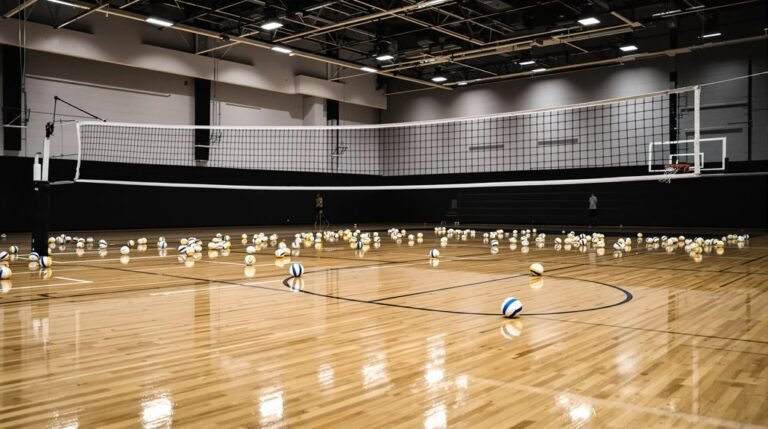


If you’ve ever watched a volleyball match and wondered how players seem to know exactly where to stand and when to move, you’re not alone. The sport looks fast and chaotic at first, but it’s built on straightforward fundamentals anyone can learn. From understanding the 9×18 meter court layout to mastering your first underhand serve, the basics aren’t as intimidating as they appear—once you know where to start.
Key Takeaways
- A standard volleyball court measures 9 by 18 meters with a center net and an attack line 3 meters from each side.
- Six players rotate clockwise one position each time their team wins serve from the opponent.
- Teams get three contacts—typically a pass, set, and attack—to return the ball over the net.
- Rally scoring awards a point every rally, with sets played to 25 points and deciding sets to 15.
- Master the ready stance with bent knees, weight forward, and hands at waist level to react quickly on defense.
Understanding the Court and Equipment
Before your child steps onto the court for the first time, it helps to know the basic layout and gear they’ll be using. A standard indoor volleyball court measures 9 by 18 meters, divided into two equal halves by a net. You’ll notice an attack line 3 meters from the net on each side—this separates front-row players from back-row players.
For this youth volleyball guide, understanding net height matters. Girls typically play with nets set at 2.24 meters, while boys use 2.43 meters. The volleyball itself is lightweight leather or synthetic, designed for easy control.
Here’s a volleyball 101 tip: any ball touching the boundary lines counts as in. This volleyball for new players rule surprises many families but becomes second nature quickly.


VOLLEYBALL TRAINING NET: Practice like the pros and warm-up before a big game to practice serving, spiking, hitting and more; 20 ft width size is also perfect for one-on-one or two-on-two scrimmage games

𝟓-𝐌𝐢𝐧 𝐒𝐧𝐚𝐩-𝐎𝐧 𝐈𝐧𝐬𝐭𝐚𝐥𝐥 + 𝟒 𝐇𝐞𝐢𝐠𝐡𝐭𝐬 → 𝐀𝐥𝐥 𝐀𝐠𝐞𝐬 𝐂𝐚𝐧 𝐏𝐥𝐚𝐲:No tools needed! Snap-on pole design clicks together in 5 minutes (plus picture manual for zero confusion), no waiting to start fun. With 4 adjustable heights (men 8’ for competitive play, co-ed 7’8’’/women 7’4’’ for casual games, plus kid-friendly height), it fits adults, teens, and kids—perfect for family gatherings or beach team matches. Save time on setup, spend more time playing!

Adjustable Height Aluminum Pole: Experience maximum durability and unparalleled stability with our 2’’ heavy-duty aluminum poles, equipped with a push-button locking system. Effortlessly adjust the volleyball net to official men's (8'), women's (7' 4"), and co-ed (7' 8") volleyball heights.
Essential Player Positions and Rotation
Now that you’re familiar with the court layout, let’s look at how players position themselves on it. A volleyball team places six players on the court: three in the front row (positions 4, 3, and 2 from left to right) and three in the back row (positions 5, 6, and 1). Front-row players can attack and block at the net, while back-row players focus on defense.
Here’s where rotation comes in. Each time your team wins the serve from the opponent, everyone shifts one spot clockwise. The player in position 2 moves back to serve from position 1. You must maintain your rotational order when the serve happens, but afterward, you’re free to move into your specialized role. The libero—wearing a different jersey—substitutes freely for back-row players.
Mastering the Three Basic Contacts
Every rally in volleyball follows a simple rhythm: pass, set, attack. You’ll use these three contacts to control the ball and create scoring opportunities. Here’s what each looks like:
| Contact | Key Technique |
|---|---|
| Pass (Bump) | Flat forearm platform, locked elbows, drive with legs |
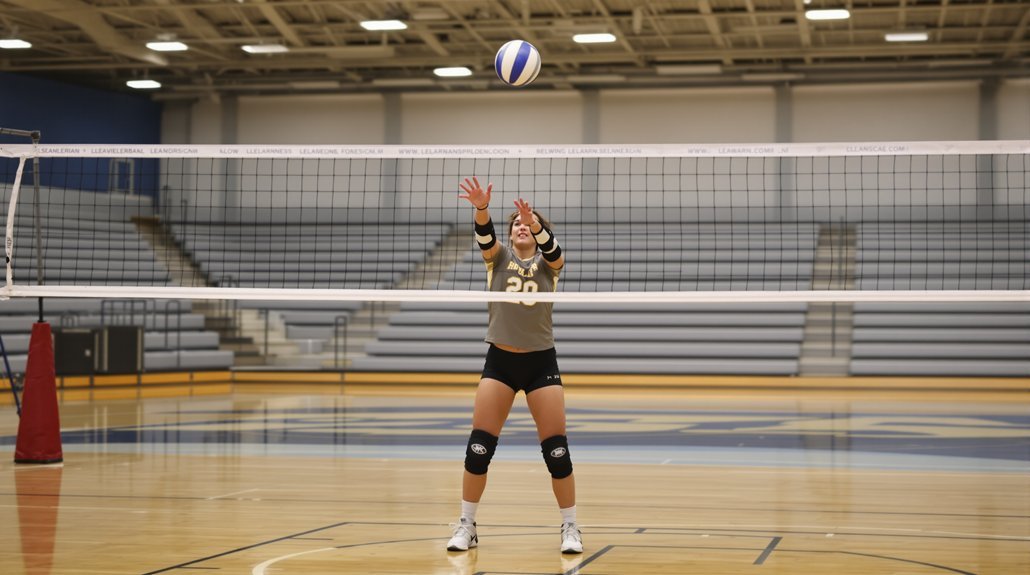
| Set | Fingertips only, triangle shape above forehead, extend through legs |
| Attack (Spike) | 3–4 step approach, explosive jump, snap wrist downward |
For your pass, place one hand over the other with thumbs parallel. Don’t swing your arms—let your legs do the work. When setting, keep the ball off your palms to avoid faults. Your attack should target gaps in the defense, whether line or cross-court. Remember, blocks don’t count toward your three contacts.

Serving Techniques for New Players
Launch the ball into play with a confident serve, and you’ll set the tone for every rally.
As a beginner, start with the underhand serve. Hold the ball at waist height in your non-dominant hand, step forward with your opposite foot, and strike the ball’s center with your dominant hand’s heel. This technique gives you control while you build consistency.
Once comfortable, progress to the overhand serve. Toss the ball 1–2 feet above your contact point and swing through with your arm fully extended. For a floater serve, hit the ball’s center with an open hand and minimal wrist snap—the erratic, spinless flight makes returns difficult for opponents.
Remember two key rules: don’t step on the baseline during contact, and always serve in your proper rotation.

Great Volleyball Gift:Focopot Volleyball Training Kit includes a ball pouch with retractable cord, an adjustable waistband, two hand straps, and a portable backpack, making it the perfect volleyball gift.

Volleyball Rebounder Kit: Elevate your volleyball training with our comprehensive equipment set! Our package includes a volleyball trainer waist belt for stability, an improved elastic cord, upgraded hand straps, two setting straps, two finger trainers, and a convenient drawstring backpack
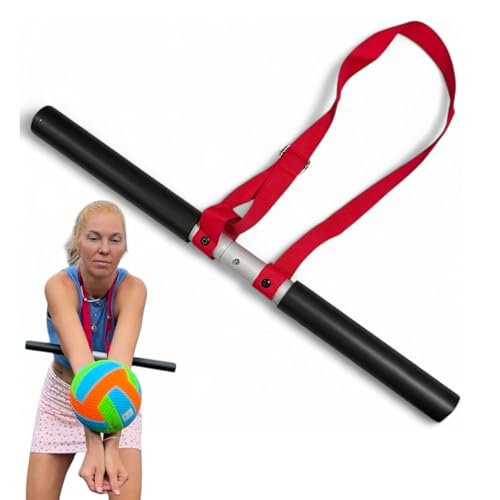
IMPROVE PASSING TECHNIQUE: The Boardee Bump-Pass volleyball gear helps you master proper arm positioning by keeping your arms straight and locked during bump-pass drills; build muscle memory for more consistent, accurate passing during solo or team practice
Defensive Skills and Ready Stance
Drop into a solid ready stance, and you’ll give yourself the best chance to reach any ball that comes your way. Stand with feet shoulder-width apart, bend your knees, and keep your weight on the balls of your feet. Position your hands between waist and chest level so you’re ready to move in any direction.
When digging or bumping, create a flat platform with your forearms. Place one hand in the other, lock your wrists and elbows, and angle the platform toward your target. Stay low with your hips back and use short, choppy steps—not long strides—to maintain balance.
Watch the setter and hitter to anticipate where the ball’s going. Communicate clearly by calling “mine” or “yours” so your team covers the court without overlap.


Fit note: This style runs small for some customers. You may prefer to size up a half size.

Fit note: This style runs small for some customers. You may prefer to size up a half size.

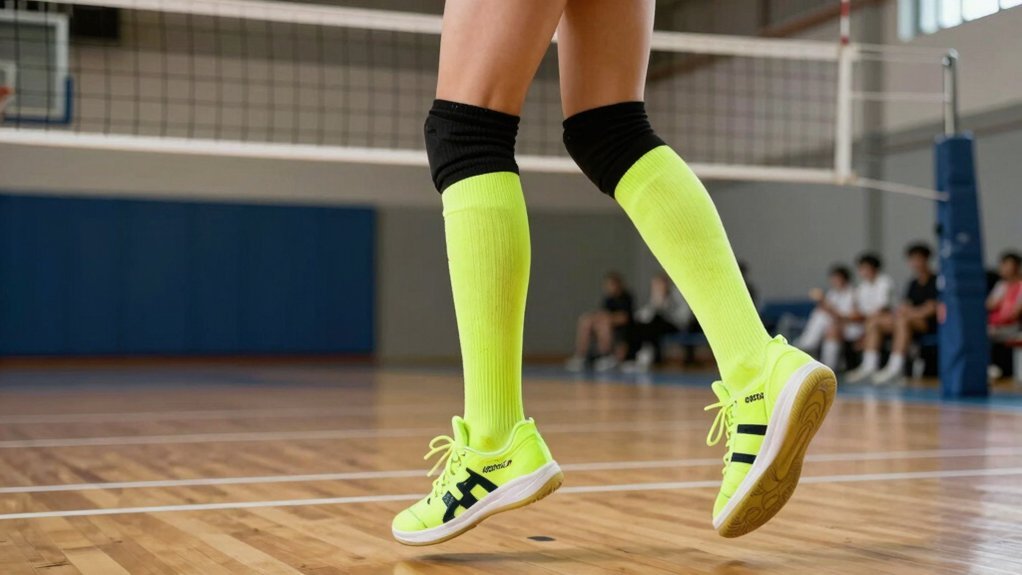
CUSTOM FIT FOR WOMEN WITH FITSYNC TECHNOLOGY: The Future Court volley ball shoes feature the FitSync 360° system, which offers a more custom fit for women.This innovative design includes a wider toe box and a secure heel to prevent slippage. For optimal comfort, we recommend ordering a half size larger than your usual athletic shoe size.
Scoring System and Match Format
Now that you’ve got the defensive basics down, let’s look at how points actually add up during a match.
Volleyball uses rally scoring, meaning every single rally awards a point to the winning team. There’s no waiting around—you score whether you served or not.
Here’s how matches work:
- Sets go to 25 points, but you must win by at least two (so a set could end 27-25 or even higher).
- Deciding sets play to 15 points, still requiring a two-point margin.
- Most matches are best-of-three or best-of-five sets.
- Teams rotate clockwise when they win the serve back from opponents.
- A coin toss determines who serves first and which side each team starts on.
Teams switch sides between sets to keep things fair.
Key Terms Every Beginner Should Know
You’ll notice one player wearing a different colored jersey—that’s the libero, a defensive specialist who rotates in for back-row players but can’t block or attack above the net.
The libero stands out in a different jersey—a back-row defensive specialist who never blocks or attacks at the net.
At the net, front-row players execute blocks (single, double, or triple) to stop attacks.
Here’s a useful detail: a blocking touch doesn’t count toward your team’s three allowed hits.
Watch for ball-handling violations too.
A double means one player contacted the ball twice consecutively.
A lift or carry occurs when the ball rests momentarily.
Four hits means the team exceeded three contacts.
Frequently Asked Questions
How to Start Playing Volleyball for Beginners?
You’ll want to start with the fundamentals: learn rally scoring, where every rally earns a point, and games go to 25.
Focus on three core skills—bumping with your forearms, setting with fingertips overhead, and spiking with a proper approach.
Master the underhand serve first, staying behind the end line.
Stay low, bend your knees, and always call “mine” to avoid collisions with teammates.
Recent Posts
What Are the 3 C’s in Volleyball?
The 3 C’s in volleyball are Communication, Coverage, and Conditioning****.
You’ll call out plays and ball locations so teammates don’t collide or miss shots.
Coverage means positioning yourself to retrieve blocked or tipped balls—front-row players handle blocks while back-row players cover deep tips.
Conditioning builds the leg strength and cardio you need for jumping and quick movements.
Master these three skills, and you’ll cut errors while creating more scoring chances.
What Are the 5 Basic Rules of Volleyball?
Five basic rules you’ll want to know: each team gets up to three hits to return the ball over the net.
Rally scoring means every play awards a point to the winner.
Sets go to 25 points, and you must win by two.
Touching the net or crossing the center line gives the other team a point.
Back-row players can’t attack above net height from inside the 10-foot line.
What Are the 5 Basic Steps in Volleyball?
The five basic steps in volleyball follow a natural rally sequence. You’ll start with the serve to put the ball in play.
Next comes the receive (or pass) using your forearms.
The set positions the ball for attack.
Then you’ll spike to drive it into the opponent’s court.
Finally, you’ll block or dig to defend against their attacks.
Bottom Line
You’ve now got the foundation to step onto a 9×18 meter court with confidence. Practice your passing, setting, and attacking until they feel natural. Master one serving style before moving to the next. Remember, volleyball rewards communication and consistent footwork more than raw athleticism. Grab a ball, find a net, and start playing. The best way to improve is simply getting reps in with teammates who share your enthusiasm.